On the morning of March 12 in Grand Rapids, Michigan, the campus scene was simultaneously typical and surreal. Students and faculty were fatigued by midterm preparations, and many were starting to feel the ill effects of too many gloomy days under our fair city’s infamously cloudy skies — it’s overcast here for 82 of 90 days in a typical winter. Inadequate sunlight weakens the immune system, so when colleagues or students fall ill in February or March, nobody is surprised. Yet this gray March morning was unlike any other, and the macabre nature of what was about to unfold was beyond anyone’s imagination.
Like collegians everywhere, mine are often glued to their social media apps, and at the conclusion of my international economics course (at about 9:45 a.m.), a group of students was huddled together with their phones, making a guffaw-filled mockery of an anonymous Instagram post. A fellow student expressed horror about the virus. They were calling on student life and the president to send everyone home — now! The anxiety-ridden demand was met with derision and laughter. Those dismissive jeers turned to shock and disbelief about fifteen minutes later, when all students, faculty, and staff joined together for our weekly community chapel.
In that 10 a.m. service, we started to hear the now loathsome words, “unprecedented,” “pivot,” “abundance of caution,” and “be sure to download Zoom.” A mere 60 minutes later, and after university leaders from across the Great Lakes state had a conference call with Governor Gretchen Whitmer, the decision was made: shut it all down.
From there, the drone-like phrases started to cascade through political pronouncements, and emails too numerous to recall. Platitudes like “we’re all in this together,” “keep your social distance,” “let’s mask up,” and “two weeks to flatten the curve” were as suspicious then as they are eye-roll-inducing now. These bromides are now seared into the minds and hearts of everyone who lived through their local, state, and federal governments’ responses to the spread of the COVID-19 virus.
As those late winter Michigan days slowly but surely gave way to spring, it became obvious that teaching and learning were not going to produce the same kinds of results that undergraduates had come to expect.
Despite the academic learning that was lost, one thing was learned by a new generation of young people: Top-down, one-size-fits-all approaches from the central planners in Lansing and D.C. couldn’t deliver the goods they promised.
“Two weeks to flatten the curve” turned into months of prolonged confinement, blank stares on Zoom calls, and false hope from political officials and celebrities, many of whom were apparently personal admirers of those issuing “recommendations” from the Coronavirus Task Force.
It came as no surprise that learning outcomes suffered. Further, it was to be expected that if students were from poorly resourced backgrounds — whether in elementary, secondary, or postsecondary schools — that they would fare worse than their peers. Indeed, they did.
Early studies on the impacts of the lockdown were published by the National Institutes of Health (NIH) just months after schools shut down. Students from low-income households suffered the greatest learning losses, similar to those seen after “shutdowns owing to hurricanes and other natural disasters.”
Two years after the lockdowns took effect, further data collected by the National Center for Education Statistics (NCES) reported in an understated way, “the pandemic has potentially impacted achievement and opportunities to learn.”
As was expected, access to the appropriate tools was one of the key drivers for worsening academic outcomes for poor children. The “digital divide” became common parlance among educators who recognized the importance of the issue. This was a critical issue, since at the outset of the lockdowns, 77 percent of public elementary and secondary schools moved online, and 84 percent of college students reported that “some or all classes moved to online-only instruction.”
Low-income households either lacked internet access at home or the hardware necessary for younger students to join class meetings or effectively participate in online learning. In fact, among households below the poverty line, nearly two-thirds lacked either a computer or adequate broadband speed for children to participate in class or finish homework.
Studies conducted by the Brookings Institution provided some of the most stark statistics in terms of poorer students falling farther behind their wealthier peers. For example, elementary schools with higher rates of poverty saw test score gaps compared to wealthier districts increase by 20 percent in math and 15 percent in reading in the 2020-21 academic year. In other words, performance fell further behind and persisted for at least 18 months.
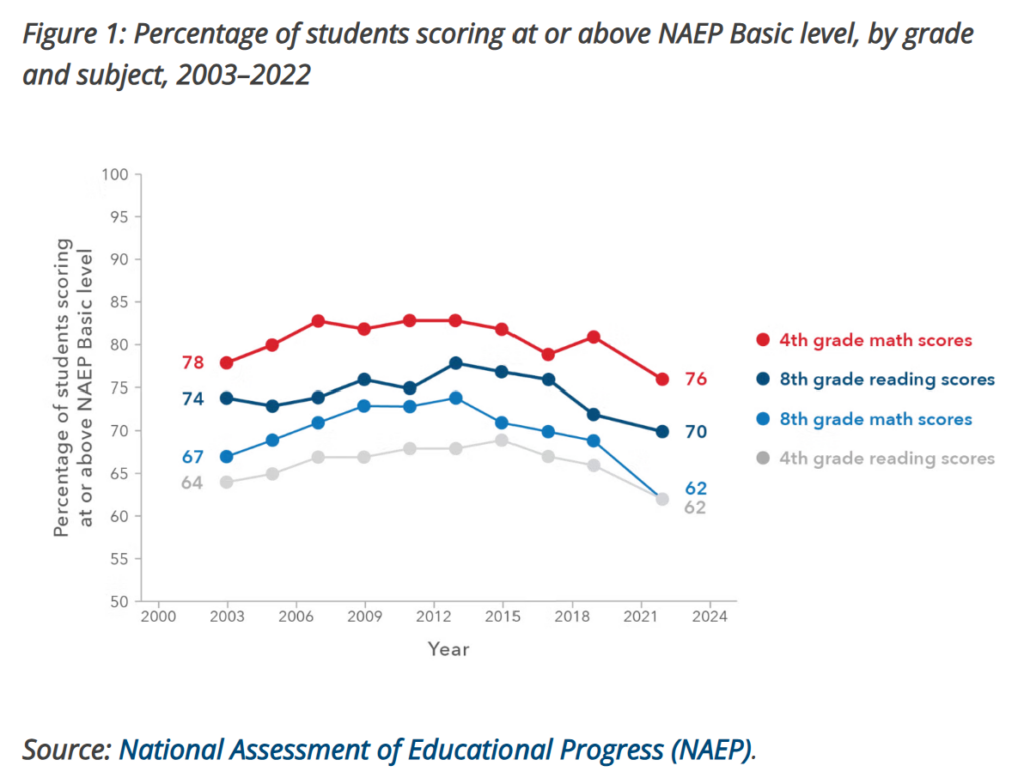
In the broader statistics, elementary scores on standardized tests saw their worst outcomes in 2023, and except for 4th-grade math scores, only 2022 was worse.
These results suggest prolonged learning loss impacts that showed up well after COVID-based school closures.
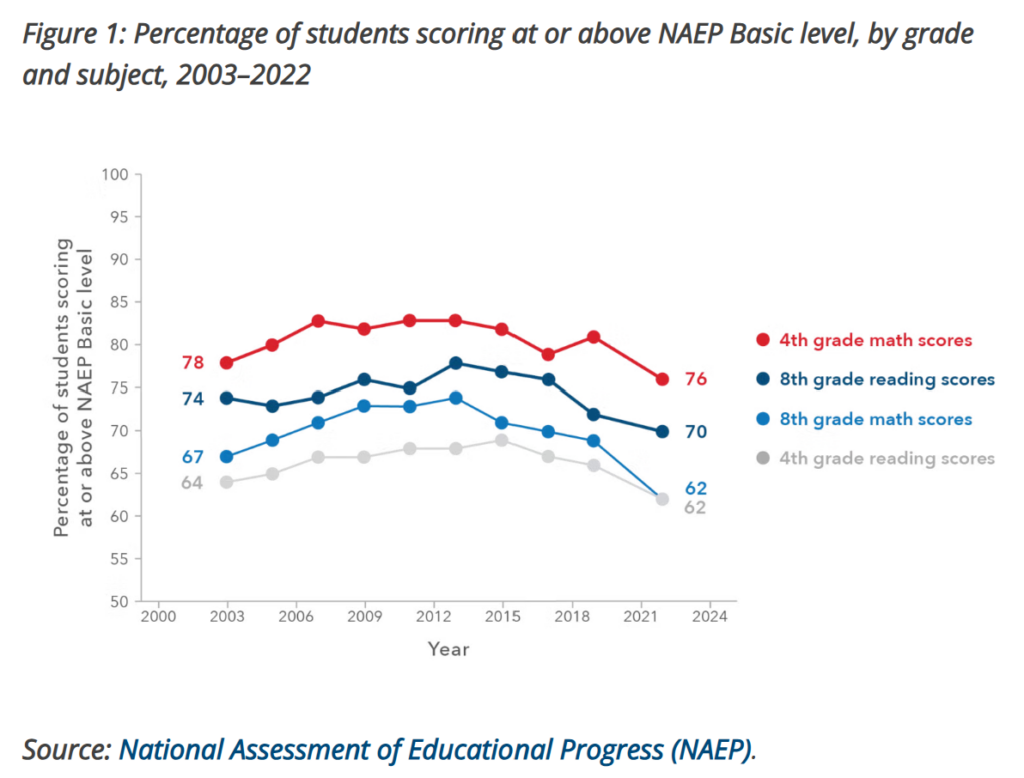
Source: Aspen Economic Strategy Group
High school upperclassmen who were gearing up for college entrance exams became ill-prepared. In a tremendous irony, test scores moved in the opposite direction of their high school GPAs. For educators on the ground, the explanation was obvious. With many districts mandating that teachers pass their students on through “no fail” policies that were either explicit or implied, regardless of their actual performance, their grades were naturally higher than would have otherwise been the case. Couple that with weaker learning, and the College Board’s report makes complete sense. Grade inflation in the classroom and a dropoff in actual learning was the predictable result.
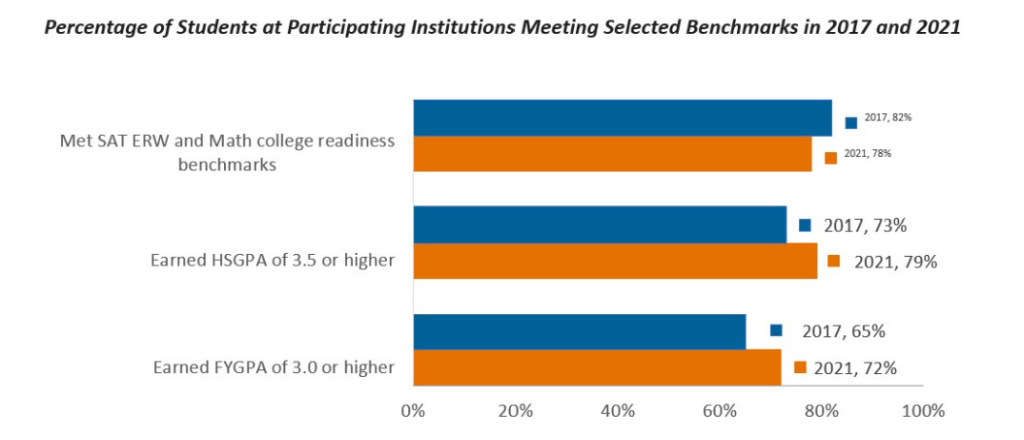
Source: The College Board
It wasn’t only academic progress that was stunted across all schooling levels. Mental health was severely damaged by school closures. A study released in 2023 showed that alongside significant educational losses, there was a rapid increase in anxiety and depression, especially among middle and high school students.
Thankfully, the COVID era wasn’t entirely bereft of bright spots. In October of 2020, the Great Barrington Declaration (GBD) recognized that “keeping students out of school is a grave injustice” and that “the underprivileged [are] disproportionately harmed.” Furthermore, its approach to the virus, described as “Focused Protection,” exhorted public officials, stating, “Schools and universities should be open for in-person teaching.”
Though the political class dismissed these common-sense measures as the work of “three fringe epidemiologists,” they nonetheless supported the young while advocating practical protections for the truly vulnerable.
Alas, despite the courage of its signatories, the GBD could not undo the damage already done. Academic learning was lost, leaving higher-education instructors to retrain students in meaningful in-person engagement. Yet this educator sees in the young a healthy skepticism of social engineers and central planners. May they — and we, their elders — remain vigilant against violations of liberty and common sense. That, perhaps, is the most valuable lesson to emerge from the COVID hysteria.