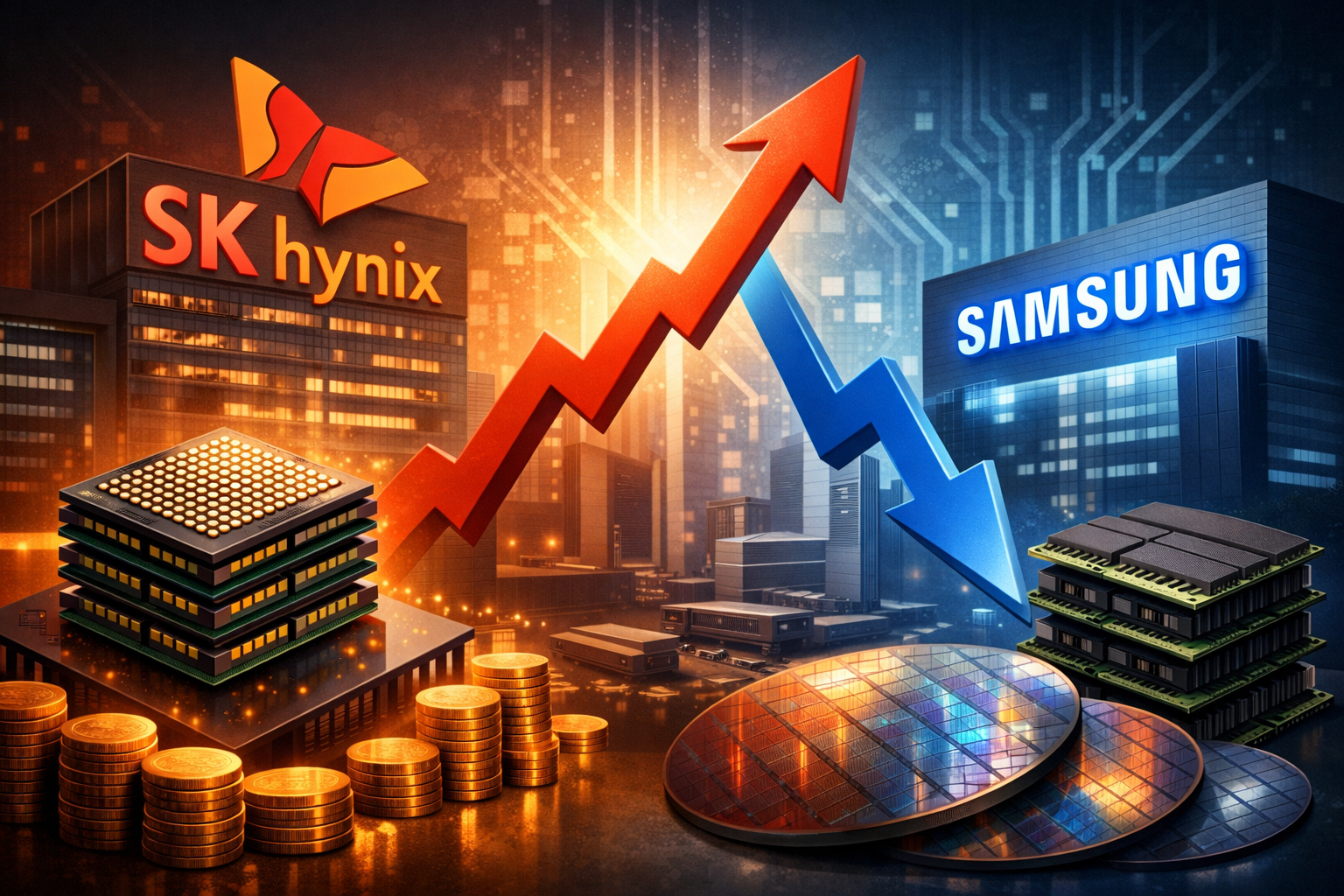
SK Hynix has overtaken Samsung Electronics in operating profit for the first time, marking a shift in South Korea’s semiconductor hierarchy as artificial intelligence reshapes the memory market.
The crossover became clear this week when the two rivals reported earnings on consecutive days.
SK Hynix’s results highlighted how leadership in advanced memory chips tied to AI infrastructure is translating into stronger profitability.
The comparison also shows how a focused strategy around high-bandwidth memory has allowed SK Hynix to move ahead of a far more diversified competitor at a moment when AI spending is accelerating across data centres and chip supply chains.
Profits tell the story
For the full year, SK Hynix reported a record operating profit of 47.2 trillion won, surpassing Samsung’s 43.6 trillion won.
Samsung remains a much larger group overall, with businesses spanning smartphones, displays, appliances, and contract chip manufacturing.
Within that structure, its memory division generated operating profits of about 24.9 trillion won in 2025.
SK Hynix, by contrast, derives nearly all of its revenue from memory chips.
That narrower focus has amplified the impact of rising demand for specialised products, particularly those used in AI servers.
As a result, gains in advanced memory pricing and volumes have flowed more directly into SK Hynix’s bottom line.
A sharper strategic focus
The latest earnings comparison also reflects how SK Hynix’s strategic positioning has evolved since its acquisition by SK Telecom for about $3 billion in 2012.
Once viewed as a second-tier memory producer, the company has steadily built scale and technical depth in high-value segments.
Its emphasis on advanced memory has become increasingly important as the industry moves beyond conventional DRAM cycles and towards AI-driven workloads.
Samsung’s diversified model provides resilience across economic cycles, but it also means that strong performance in memory does not dominate group earnings in the same way.
In an environment where AI infrastructure spending is becoming a key profit driver, SK Hynix’s concentration has proved advantageous.
High bandwidth memory advantage
At the centre of SK Hynix’s rise is its leadership in high-bandwidth memory, or HBM.
These chips are essential for AI processors and servers, including those supplied to Nvidia.
Industry researchers say SK Hynix has established an early and sustained lead in both the quality and supply of HBM, allowing it to secure a large share of AI-related contracts.
This advantage has held even as Samsung regained the top spot in overall memory revenue rankings in the fourth quarter of 2025.
According to Counterpoint estimates released in December, SK Hynix held a 57% revenue share of the HBM market in the third quarter of last year, compared with Samsung’s 22%.
The gap illustrates how leadership in a fast-growing niche can outweigh broader revenue gains elsewhere.
Rivals close the gap
Competition is intensifying as rivals work to narrow that lead.
Samsung has expanded its HBM sales and has said it remains on track to begin delivering HBM4 products, the sixth generation of the technology, this year.
Analysts tracking the AI supply chain expect Samsung to recover from last year’s quality issues and show a stronger performance with HBM4 tied to new AI processors.
Even so, expectations remain that SK Hynix will retain a dominant position.
Analysts see the HBM4 race largely as a two-player contest between SK Hynix and Samsung, with both ahead of Micron in competitiveness.
While Samsung is expected to make material progress, SK Hynix is forecast to maintain a high market share as demand for AI servers continues to grow.
A local media report on Wednesday said SK Hynix had secured more than two-thirds of HBM supply orders for Nvidia’s next-generation Vera Rubin products.
Beyond HBM, SK Hynix has also edged ahead of Samsung in the broader DRAM market.
DRAM chips are used for temporary data storage across personal computers, servers, and data centres, reinforcing SK Hynix’s position across memory categories most exposed to AI-driven demand.
The post How SK Hynix leapfrogged Samsung in the AI-driven memory race appeared first on Invezz
