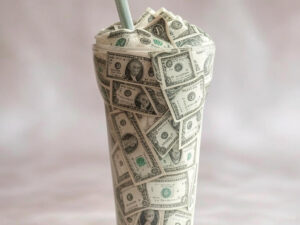
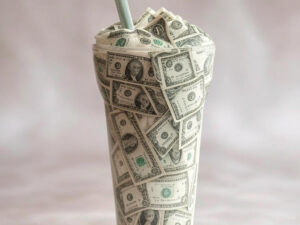
The Dollar Milkshake Theory, a growing topic of debate on YouTube, Reddit, and other social platforms, claims to offer a framework for explaining the US dollar’s strength in an era of expanding liquidity. It posits that global liquidity injections — largely a product of excessive monetary easing by central banks — are ultimately siphoned into US assets, strengthening the dollar and exerting deflationary pressure on weaker currencies.
While there are elements of truth to this framework, the theory is fundamentally flawed. It assumes that distortions caused by state intervention are not just inevitable but permanent, and it ignores the long-term economic consequences of financialization generated by artificial credit expansion. Moreover, it misreads the actual trajectory of global monetary dynamics, particularly as dedollarization gains traction in response to America’s fiscal mismanagement and weaponization of its currency.
Artificial Liquidity and Malinvestment
At its heart, the Dollar Milkshake Theory relies on the notion that the Federal Reserve’s policies will always create an economic environment where capital is drawn disproportionately to US assets. Even if this is the case, it is not a feature of the markets or superiority, but a function of expansionary monetary policy distortions. A constant supply of artificially cheap credit and market interventions have created a global economic order in which capital is allocated not based on productivity, innovation, or comparative advantage, but instead on the relative ease of financial arbitrage within a system dominated by the Fed and other major central banks.
It’s an arrangement that leads to severe malinvestment, where capital flows not to where it is most efficient, but rather to where it is temporarily most attractive due to manipulated interest rates and financial repression. Instead of productive investment in industries that drive organic economic growth, we see speculative bubbles: artificial intelligence stocks, real estate, US Treasuries, Pokemon cards, non-fungible tokens, and beyond. The problem is not only that bubbles shunt investment away from more deserving areas, but that they are not sustainable in the long run — the moment the Fed reverses its expansionary policies, or the global financial system starts restructuring, these flows will dry up, leading to painful unwinding of the imbalances.
The Fragility of Dollar Hegemony
Another core weakness in the Dollar Milkshake Theory is its assumption that the dollar will remain permanently dominant because global institutions and sovereign entities have no alternative. This is a mistake. Markets, when allowed to function properly, do not tolerate monopolies indefinitely. Just as inefficient businesses lose market share to more competitive firms, inefficient financial structures give way to more viable alternatives. The current trajectory of global trade and finance suggests that dedollarization is not just theoretical — it has begun.
China, Russia, and a growing coalition of emerging markets have been actively reducing their dependence on the US dollar in trade settlements. The rise of currency swaps, central bank digital currencies (CBDCs), and alternative trading mechanisms (such as BRICS’ push for a commodity-backed reserve currency) all suggest that the dollar’s hegemony is not guaranteed. Additionally, the US government’s willingness to use the dollar as a tool of financial coercion — sanctions, asset freezes, and trade restrictions — has accelerated global efforts to diversify reserves away from the greenback. While the milkshake theory assumes that dollar dominance is reinforced through financial gravity, other spheres have their own gravity, which is pulling toward alternatives.
Monetary Competition
A better solution is not an unchallenged dollar absorbing global liquidity, but a monetary system where currencies compete freely. The current dollar-dominant system is not the result of market forces but of decades of government privilege—Bretton Woods (1944), the informal but consequential petrodollar agreement, and decades of Federal Reserve intervention. (If President Trump has his way, sanctions against nations using anything but the dollar may soon be in place.) In a truly free market, money would emerge naturally through competition, and its value would be determined by its qualities as a medium of exchange, a store of value, and a unit of account — not through financial engineering and central bank intervention.
Gold, Bitcoin, and commodity-backed currencies are potential competitors to the dollar that have been suppressed or marginalized by policy-driven mechanisms. While the Dollar Milkshake Theory acknowledges the capital-absorbing nature of the dollar, it fails to recognize that this phenomenon is itself a symptom of financial repression, rather than market efficiency. A free market would correct these distortions by allowing alternative currencies to emerge and compete without state-imposed barriers.
To its credit, the Dollar Milkshake Theory correctly observes that the short-term appeal of US assets is frequently a product of the conditions set by global monetary easing. That fails, however, as a long-term economic model. Distortions created by government intervention are sticky and lead to instability and correction. More critically, it ignores the growing move toward dollar alternatives, an inevitable consequence of free-market forces working against rigging and coercion.
Economic freedom is not defined by an endlessly dominant dollar, but rather a world wherein monetary competition is allowed — indeed, encouraged — to flourish. The global economy is already moving in that direction, and the longer investors and policymakers rely on the outdated assumptions of dollar hegemony, the more painful the transition will ultimately be. Half-baked theories will only compound the eventual cost.