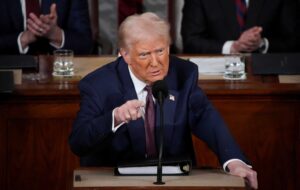
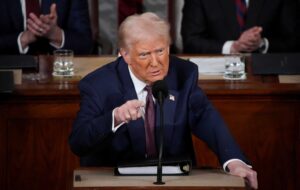
President Trump is bringing federal agencies to heel. Is the Federal Reserve next?
Our nation’s central bank jealously guards its independence from politics. Given its inflation-fighting and financial stability-preserving mandates, that might seem like a good thing. You don’t need a PhD in economics to see how political meddling in monetary policy or bank regulation could create economic chaos.
Yet Fed independence has been greatly overstated. Congress sets the Fed’s goals: it has tasked the Fed with delivering maximum employment and stable prices. Top Fed policymakers are selected by the president and approved by the Senate. Constitutionally, the Fed can’t be separated from politics. Elected officials have the last word. Our only choice is whether that authority is exercised responsibly.
Prior to the 2024 election, Trump lambasted the Fed for its interest-rate decisions. Stephen Miran, Trump’s nominee to chair the Council of Economic Advisers, recently co-authored a report that called for major Fed reforms to promote “accountability and democratic legitimacy.” While the Fed’s core duties remain off-limits to Trump’s regulatory overhaul, the administration clearly wants to subordinate the central bank to its political objectives.
Most commentators are worried about the effects a Trump-influenced Fed would have on the US economy. However, the ramifications are far greater for the world economy. The Fed’s role in maintaining worldwide dollar dominance hasn’t received sufficient attention.
We need to start looking at the Fed as a piece on a much larger policy chessboard. Trump’s radical departures from economic orthodoxy on tariffs and government investment suggest a new paradigm for international economic policy. The Fed would play a big part.
The president is a pragmatic dealmaker. His advisers have ambitious plans to restructure US trade and financial relationships with other countries. The bargainer-in-chief will support these plans insofar as they help preserve and strengthen his electoral coalition. So far, grand strategy has aligned with hardball politics. That means the Fed is ripe for picking.
The Fed’s Global Role
A globally focused Fed is best understood as a national underwriter of global dollar hegemony. All the world uses dollars, and foreign government organizations (such as central banks) hold large stocks of Treasury debt. The United States must constantly send dollars and debt abroad to satisfy world demand for assets.
The Fed, whether legally acknowledged or not, is responsible for ensuring adequate dollar liquidity and financial stability across the globe. Domestic policies have international spillovers.
The Fed also can significantly influence domestic borrowing rates, which affect the market for Treasuries. Since official foreign entities use Treasuries as reserve assets, these assets’ prices and quantities matter greatly for international solvency.
Monetary policymakers already know that the dollar and hence the Fed are major factors shaping the global economy. The Fed maintains swap lines with several other central banks, which help provide emergency dollar liquidity on short notice. It also operates international repo facilities, whereby counterparties can temporarily exchange their Treasury holdings for dollars.
A Trumped-up Fed
The critical difference under a Trump-realigned Fed is not about means but ends. Traditional international monetary goals would take a backseat to geopolitical considerations. Existing Fed facilities, policies, and governance procedures would focus less on stabilizing global markets and more on advancing national interests as determined by the president and his advisers.
Under the new monetary dispensation, expect the Fed to target government borrowing rates directly. It pegged Treasury yields during World War II to help the government keep capital prices low and predictable. The same would likely occur if a confrontation broke out with China, Russia, Iran, or North Korea.
The Fed could also intervene in foreign-exchange markets. Fed asset purchases or sales could be a tool for the government to achieve a desired price for dollars. This would be difficult since harnessing this power for strategic purposes would almost certainly invite reprisals. But if Trump and his allies are bold enough to repurpose the Fed, they’re likely bold enough to take their chances on targeted exchange rate interventions, too.
In addition, the Fed could use its bank-supervision duties to scrutinize banks with foreign ties. It operates Fedwire, a widely used payments processing and settlement system, and helps the Treasury monitor and enforce financial sanctions. Selectively denying payments and ensuring compliance with foreign-asset restrictions or freezes would become more frequent.
The Peril of the Fed as a Geopolitical Tool
If all this sounds ominous, that’s because it is. The Fed’s transition from a domestic economic stabilizer to a geopolitical enforcer carries major risks. Most obviously, the additional need for expansionary monetary policy — to lower Treasury costs or hit an exchange-rate target, for example — would worsen inflation at home. Trump was elected largely on the promise to get price pressures under control. Keeping that promise would be hard if he unleashes the Fed on foreign foes.
Furthermore, the Fed’s imposition of costs on international rivals would weaken the appeal of holding dollars and dollar-denominated assets. It’s a catch-22: monitoring, sanctions, and payment denials are effective threats because everyone wants to use the dollar, but executing those strategies would lower the demand for dollars. The dollar’s lofty status is an invaluable American asset. The consequences of treating it cavalierly could be severe.
Part of the uncertainty hanging over the Fed is its own fault. There would not be a push to control the Fed if it had not done such an abysmal job stewarding the economy since the 2008 crisis. That doesn’t mean we should welcome the new monetary paradigm with open arms. The benefits of a Trumped-up Fed are speculative. The costs are real.
If top Fed decision-makers want to forestall a Trump takeover, the best thing they could do is bring inflation down and quit bailing out Wall Street every time it has to take a haircut. The political demands on the Fed will abate if monetary policymakers focus on their core duties and start performing them well.