

Enterprise IoT’s evolution toward operational autonomy signals that value will concentrate around decisioning and execution rather than connectivity or data collection. Vendors built around generic platforms or dashboarding risk disintermediation as customers prioritize domain-specific stacks that close the loop from sensing to action. The widening autonomy maturity gap will reshape competitive dynamics, driving M&A and ecosystem consolidation around “autonomy leaders.” This shift aligns IoT more tightly with AI, edge, and private networking trends, accelerating convergence of IT, OT, and network domains.
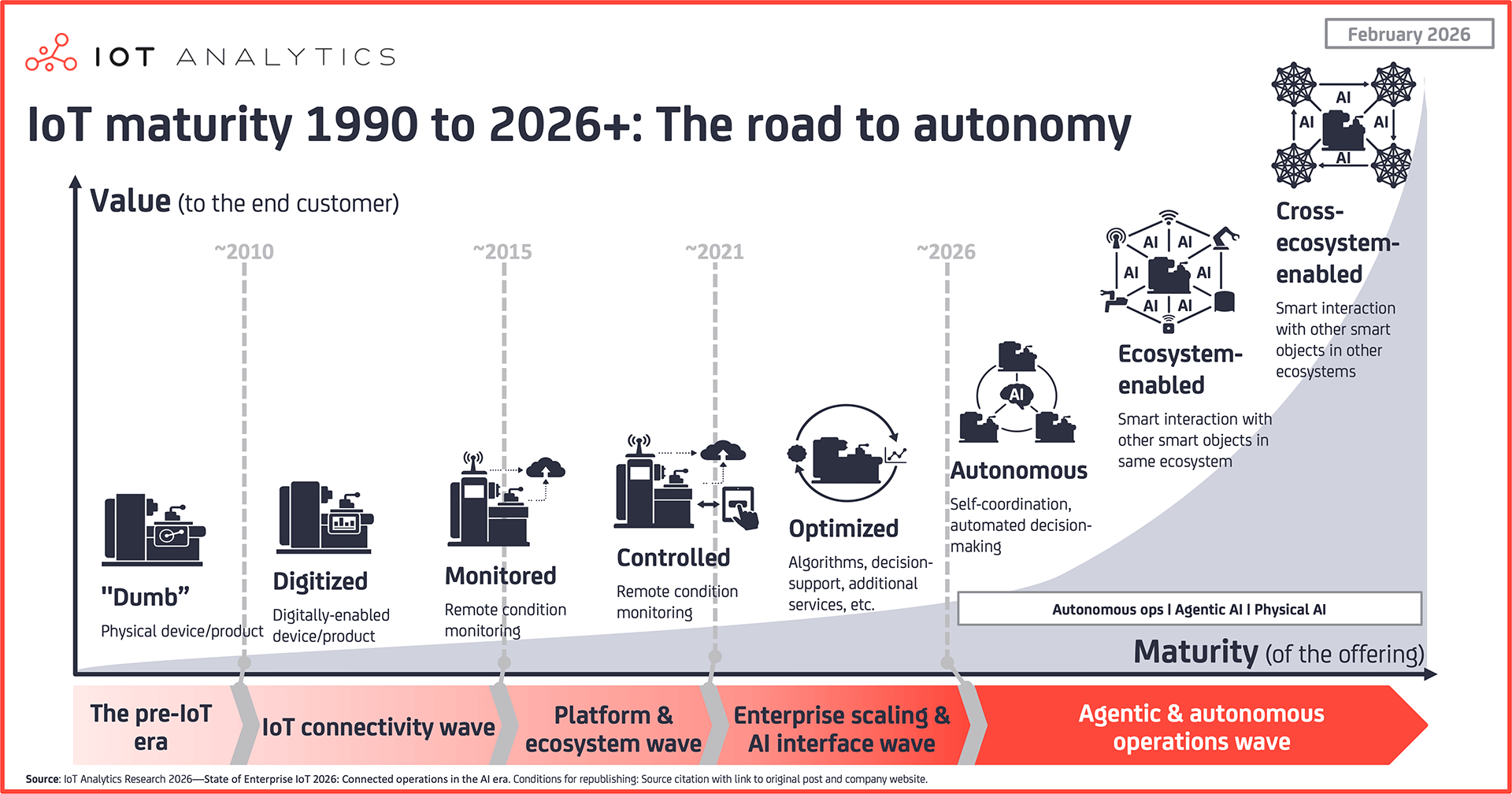
The latest analysis from IoT Analytics, State of Enterprise IoT 2026, captures a shift that many industrial players quietly acknowledge but rarely articulate clearly: enterprise IoT is no longer about connectivity or visibility — it is about operational autonomy.
This evolution is neither sudden nor uniform. It is the result of more than a decade of IoT deployments colliding with real-world constraints: labor shortages, cost pressures, fragmented IT/OT stacks, and the limits of human-centric operations. From a journalist’s perspective, the most interesting part of the report is not what it confirms — but what it implicitly declares obsolete.
The End of “IoT as a Project”
One of the clearest signals in the report is the disappearance of IoT as a standalone initiative. Enterprises are no longer asking “Should we deploy IoT?” or even “How do we scale IoT?”. Those questions belong to the 2015–2020 era. Instead, IoT is now:
- embedded into operational processes,
- evaluated through business KPIs,
- and increasingly invisible as a distinct technology layer.
This is a crucial point. When IoT fades into the background, it has succeeded — but it also loses its immunity. Platforms, devices, and connectivity are now judged like any other operational component: on resilience, ROI, and contribution to outcomes.
For vendors still positioning IoT as an innovation project or a “digital transformation enabler”, this is a warning sign.
From Dashboards to Decisions — and Beyond
The report rightly emphasizes the transition from descriptive to prescriptive and autonomous operations. In practice, this marks the end of dashboard-centric IoT.
Many enterprises already suffer from what could be called dashboard fatigue:
- dozens of KPIs,
- real-time alerts,
- beautifully designed interfaces,
- but very limited operational action.
What changes now is the expectation that systems should:
- detect anomalies,
- contextualize them using multiple data sources,
- decide on corrective actions,
- and execute them automatically — or at least recommend them with high confidence.
This is where IoT, analytics, AI, and automation finally converge. Not as buzzwords, but as a necessity to cope with operational complexity at scale.
Autonomous Operations: Ambition vs. Reality
While the narrative around autonomous operations is compelling, it deserves nuance.
In reality:
- fully autonomous operations remain rare, confined to well-bounded use cases,
- most enterprises operate in semi-autonomous modes, with humans still in the loop,
- trust in automated decision-making is uneven across industries.
Regulated sectors, safety-critical environments, and legacy-heavy operations move more cautiously — and for good reason. Autonomy is not just a technical challenge; it is an organizational, cultural, and legal one.
The report implicitly acknowledges this by framing autonomy as a progressive maturity path, not a binary state. That framing is essential to avoid inflated expectations.
Connectivity Becomes Strategic Again
An interesting undercurrent in the analysis is the renewed importance of connectivity — not as a commodity, but as an enabler of autonomy.
As operations become more distributed, more mobile, more real-time, and more cross-domain, enterprises are rediscovering that network reliability, latency, redundancy, and coverage directly impact their ability to automate decisions.
This explains the growing interest in hybrid connectivity models, private cellular networks, satellite IoT and NTN, and multi-bearer strategies.
Autonomous operations cannot exist on best-effort connectivity alone.
Platforms Are Under Pressure
The report also highlights a market tension: traditional horizontal IoT platforms are losing their centrality.
Enterprises increasingly favor: vertical-specific solutions, tightly integrated stacks, or composable architectures aligned with existing IT/OT systems.
The promise of “one platform for all IoT use cases” has largely failed in industrial environments. What matters now is time to outcome, not architectural purity.
This has profound implications for platform vendors, system integrators, and cloud providers alike.
A Maturity Gap That Will Shape the Market
One of the most important — and often overlooked — takeaways is the growing maturity gap between enterprises.
Some organizations are already orchestrating connected, semi-autonomous operations across multiple sites and assets. Others are still struggling with:
- device onboarding,
- data quality,
- cybersecurity basics,
- or internal alignment between IT and operations.
This gap will increasingly define competitive advantage, operational resilience, and even the viability of certain business models.
IoT is no longer a differentiator by itself. Operational intelligence and autonomy are.
Final Take: IoT Has Grown Up — and So Have Expectations
The State of Enterprise IoT report confirms what many practitioners sense daily: IoT has entered its post-hype phase. It is no longer about connecting things. It is about running operations differently.
For enterprises, this means harder questions, fewer experiments, and higher accountability.
For vendors, it means sharper positioning and deeper domain expertise.
For the IoT ecosystem as a whole, it marks a transition from promise to proof.
In that sense, the move from IoT to autonomous and connected operations is less a technological revolution than a coming-of-age moment — one that will reward pragmatism over vision slides.
And that, for once, is good news for the industry.
The post From Connected Devices to Autonomous Operations: What Enterprise IoT Is Really Becoming appeared first on IoT Business News.
