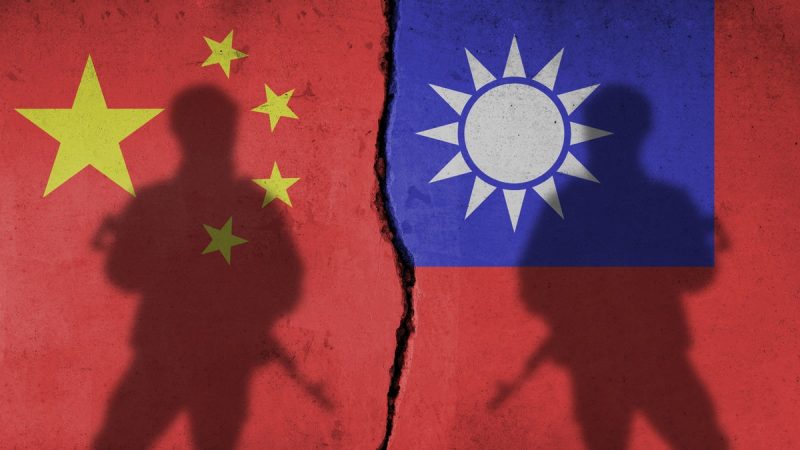
The Trump administration asked for redactions to a sweeping new Heritage Foundation report modeling a potential U.S.–China war over Taiwan, even though the analysis relied entirely on publicly available, unclassified data, according to the report’s authors.
The redacted report, TIDALWAVE, warns that the United States could reach a breaking point within weeks of a high‑intensity conflict with China — conclusions that the authors say prompted senior national security officials to seek redactions over concerns adversaries could exploit the findings or use them to identify U.S. and allied military vulnerabilities.
Those conclusions include warnings that U.S. forces would culminate far sooner than China, suffer catastrophic losses to aircraft and sustainment infrastructure in the Pacific, and still fail to prevent a global economic shock estimated at roughly $10 trillion, nearly a tenth of global GDP.
According to the report’s authors, the AI‑enabled model drew exclusively on open‑source government, academic, industry and commercial information. An unredacted version of the report was provided to authorized U.S. government recipients for internal use.
Unlike traditional tabletop war games, TIDALWAVE employs an AI‑enabled model that runs thousands of iterations, tracking how losses in platforms, munitions, and fuel compound over time and drive cascading operational failure early in the conflict.
According to a Heritage spokesperson, the report had been shown to ‘high-level national security officials’ who requested some of the specifics be crossed out in black ink before its release to the public. The report still details how quickly U.S. forces could reach a breaking point and why the conflict would carry global consequences.
‘Redactions were made at the request of the U.S. government to prevent disclosure of information that could reasonably enable an adversary to (1) re mediate or ‘close’ critical vulnerabilities that the United States and its allies could otherwise exploit, or (2) identify or exploit U.S. and allied vulnerabilities in ways that could degrade operational endurance, resilience, or deterrence,’ the report said.
A Department of War spokesperson declined to comment on discussions surrounding TIDALWAVE’s publication, but added: ‘The Department of War does not endorse, validate, or adjudicate third-party analyses, nor do we engage publicly on hypothetical conflict modeling. As a general matter, we take seriously the protection of information that, if aggregated or contextualized, could have implications for operational security.’
The White House could not be reached for comment.
The war is decided early
According to the report’s redacted findings, the U.S. would culminate in less than half the time required for the People’s Republic of China in a high-intensity conflict. Culmination is defined as the point at which a force becomes incapable of continuing operations due to the loss of platforms, ammunition and/or fuel.
The report is explicit that the first 30 days to 60 days of a U.S.-China war determine its long-term shape and outcome, as early losses in aircraft, ships, fuel throughput and munitions rapidly compound and cannot be recovered on operationally relevant timelines.
The report concludes that the U.S. is not equipped nor arrayed to protect and sustain the Joint Force in a conflict with China in the Indo-Pacific. Rapid platform attrition, brittle logistics, concentrated basing and insufficient industrial surge capacity combine to force an early operational breaking point for American forces.
Catastrophic losses in the Pacific
The report warns that U.S. reliance on a few large, concentrated forward bases — particularly in Japan and Guam — leaves American airpower dangerously exposed to Chinese missile forces.
In multiple scenarios, up to 90% of U.S. and allied aircraft positioned at major forward bases are destroyed on the ground during the opening phase of the conflict, as runways, fuel depots, command facilities and parked aircraft are hit simultaneously.
Munitions collapse within days
The report finds that critical U.S. precision‑guided munitions — including long‑range anti‑ship missiles, air‑to‑air interceptors and missile‑defense systems — begin to be unavailable within five to seven days of major combat operations. Across most scenarios, those critical munitions are completely exhausted within 35 days to 40 days, leaving U.S. forces unable to sustain high‑tempo combat.
Fuel emerges as the most decisive vulnerability of all. The report makes a critical distinction: the U.S. does not run out of fuel in most scenarios — it loses the ability to move fuel under fire.
Chinese doctrine explicitly prioritizes attacks on logistics vessels, ports, pipelines and replenishment tankers. Even limited tanker losses, port disruptions or pipeline severance are sufficient to drive fuel throughput below survivable levels, forcing commanders to sharply curtail air and naval operations despite fuel remaining in aggregate stockpiles.
China endures far longer
By contrast, China is assessed as capable of sustaining high‑intensity combat operations for months longer under the modeled assumptions.
Chinese ammunition stockpiles of critical munitions begin to be depleted after approximately 20 days to 30 days of major combat operations. However, substitution effects extend China’s ability to sustain combat operations out to months — well beyond the point at which U.S. forces culminate, according to the report.
A $10 trillion global shock
The consequences extend far beyond the battlefield.
The redacted report concludes the U.S. is highly unlikely to prevent massive global economic fallout once a Taiwan conflict begins.
Disruption of shipping lanes, destruction of critical infrastructure and the collapse of Taiwan’s semiconductor production would trigger a global economic shock estimated at roughly $10 trillion, with enduring ripple effects across financial markets, manufacturing and global trade.
Wartime footing for rebuilding the industrial base
The report comes amid years of concern over U.S. military readiness and industrial capacity, as China rapidly expands its naval forces and shipbuilding base.
The U.S. Navy operates a smaller fleet than planned, while American shipyards face workforce shortages, aging infrastructure and chronic delays — even as China, the world’s largest shipbuilder, continues to outpace the U.S. in producing new naval hulls.
War Secretary Pete Hegseth and other military leaders have vowed to put the Pentagon on a wartime footing for industrial capacity.
Deterrence at risk
Perhaps most alarming, TIDALWAVE warns that the scale of losses in the Indo‑Pacific would leave the U.S. unable to deter or respond effectively to a second major conflict elsewhere in the world.
A war over Taiwan could open the door to follow‑on aggression by adversaries such as Russia, Iran or North Korea, fundamentally destabilizing the global security order.
The report is blunt in its assessment: existing Pentagon programs and congressional funding are too slow, too fragmented and too modest to address the scale of the challenge. In many cases, the timeline required to fix critical vulnerabilities exceeds the likely timeline to conflict.
The call to action
To avoid what the authors describe as a strategic defeat, the report urges Congress to immediately expand munitions stockpiles, strengthen fuel reserves and distribution infrastructure, harden and disperse forward bases, and accelerate sustainment and logistics reforms. Without rapid action, the authors warn, the U.S. risks entering a conflict it is structurally unprepared to fight or sustain.
With intelligence warnings mounting that China could move on Taiwan before the end of the decade, TIDALWAVE cautions that the window to correct these deficiencies may be closing faster than Washington is prepared to act.