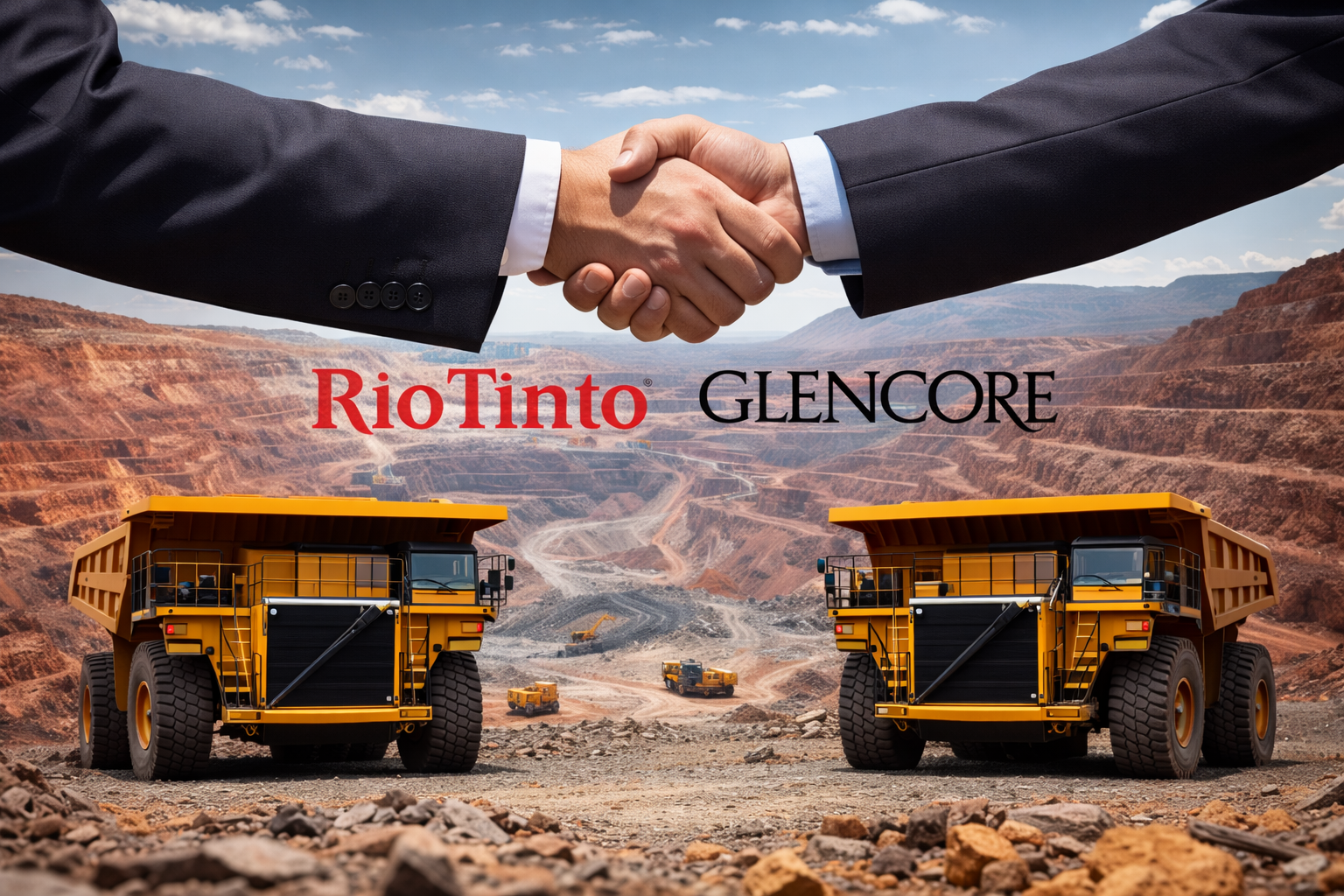
Rio Tinto and Glencore have confirmed they are in preliminary discussions over a potential deal that could create the world’s largest mining company, with a combined market value exceeding $200 billion.
The talks mark a renewed attempt at consolidation in a sector being reshaped by surging demand for copper and other critical metals.
Both companies said on Friday that they that they were in “preliminary discussions” about a “possible combination of some or all of their businesses, which could include an all-share merger”.
“The parties’ current expectation is that any merger transaction would be effected through the acquisition of Glencore by Rio Tinto by way of a court-sanctioned scheme of arrangement,” Rio Tinto said in a statement.
“There can be no certainty that an offer will be made or as to the terms of any such offer, should one be made.”
The announcement sent Glencore shares up nearly 9%, pushing them to their highest level since July 2024, while Rio Tinto’s stock fell sharply, reflecting investor caution over the scale and complexity of a potential deal.
A return of megadeals after years of restraint
The renewed talks underscore a shift in thinking among mining executives, who for much of the past decade avoided large acquisitions after a wave of expensive deals during the China-driven commodities boom left investors nursing losses.
At the time, shareholders pushed miners to prioritise capital discipline, dividends, and share buybacks over empire-building.
Now, however, fears that existing project pipelines are insufficient to meet future demand have brought dealmaking back into favour.
Jefferies analysts said the discussions between Rio Tinto and Glencore signal that mining megamergers are returning, driven by structural changes in global metals demand rather than cyclical price spikes.
Recent precedent supports that view.
In September, London-listed Anglo American completed a $53 billion merger with Canada’s Teck Resources, combining two major copper producers.
Earlier, BHP Group’s £39 billion approach for Anglo and Glencore’s £16.6 billion bid for Teck were both rejected, highlighting how contested the race for quality assets has become.
Copper sits at the heart of the talks
Copper is widely seen as the strategic prize behind the Rio-Glencore discussions.
Prices hit an all-time high above $13,300 a tonne this week, with analysts warning of a potential supply shortfall of up to 10 million tonnes by 2040 as demand accelerates from electric vehicles, renewable energy infrastructure, data centres, and artificial intelligence.
Rio Tinto exited the coal industry in 2018 and has been seeking to reduce its reliance on iron ore, which accounted for nearly 80% of its earnings as recently as 2024.
“A combined company without coal would make most of its money from copper, followed by iron ore and aluminium,” Jefferies said.
Berenberg analysts Richard Hatch and Jasper Mainwaring noted that Glencore has already begun preparing less-attractive units for potential divestment.
Its coal and ferroalloys businesses have been placed into a separate vehicle that could be spun off, a move that would make a combined entity more attractive from a decarbonisation perspective while sharpening its focus on copper.
RBC Capital Markets’ analyst Ben Davis said Glencore has been marketing itself for a sale for a while.
“Examples include exploring a carve-out of its less-desirable units and touting its copper potential.”
Glencore has been positioning itself as a copper-led growth company, with chief executive Gary Nagle saying in December that the group aims to become the world’s largest copper producer.
Currently the world’s sixth-largest producer of copper and the biggest listed coal miner, Glencore plans to lift output through projects including the development of the El Pachón copper mine in Argentina.
If completed, these initiatives would raise its annual copper production to about 1.6 million tonnes by 2035, nearly double current levels.
Possible deal structures and strategic hurdles
Several possible deal structures are being discussed by analysts, though all come with complications.
Jefferies suggested one option could involve merging Rio Tinto’s and Glencore’s iron ore and coal operations into an Australian-listed entity, while housing base metals in a separate company.
Such a structure, however, could prove difficult to execute and carry a significant tax burden.
Another scenario is for Glencore to offload its coal business entirely before selling itself to Rio Tinto.
Coal remains a key obstacle, given Rio’s decision to exit the sector in 2018 as part of a broader decarbonisation push.
Jefferies cautioned that Glencore is unlikely to agree to a deal without a premium, pushing back against the idea of a nil-premium merger.
Any acquisition would therefore need to balance Rio’s desire for copper growth with shareholder concerns about overpaying at a time when copper prices are at record levels.
RBC’s Davis said the combination would unlock value for Glencore shareholders, but its coal business could be an obstacle to any deal.
Rio Tinto’s investors’ reaction reflects deep scepticism
The immediate market response highlighted those concerns.
Rio Tinto shares fell more than 6% in Australia and over 2% in London.
Hugh Dive, chief investment officer at Atlas Funds Management, said the sell-off showed investors were uncomfortable with what he described as a strategic U-turn.
He noted that Rio’s new chief executive, Simon Trott, had recently promised to keep the business simple, only to now pursue a complex and risky acquisition.
While supportive of greater copper exposure, Dive warned that large mining mergers have a poor track record, often struck at the top of the market and proving dilutive over time.
He drew parallels with the BHP-Billiton merger two decades ago, arguing that many of the acquired assets ultimately delivered little value.
Others were more measured.
Andy Forster, senior portfolio manager at Argo Investments, said a deal could make sense if the terms were right, though he highlighted cultural differences as a key risk.
Glencore’s trading-driven, opportunistic culture could clash with Rio Tinto’s more operationally focused approach, but Forster said some aspects of that mindset might benefit Rio if managed carefully.
Leadership change adds another layer
The talks come just months after Rio Tinto overhauled its leadership team, appointing Simon Trott as chief executive.
In early communications with staff, Trott promised fundamental changes, later outlining plans to cut costs and sell assets.
His willingness to explore a transformational merger so soon into the role has surprised some investors.
A sector at a crossroads
Whether the talks result in a deal remains uncertain, but their revival highlights a broader shift across the mining industry.
With new mines taking years to develop and facing permitting and cost challenges, acquisitions offer a faster route to growth.
At the same time, the risks of scale, integration, and valuation loom large.
As the global economy pivots toward electrification and digital infrastructure, copper’s strategic importance is reshaping boardroom priorities.
For Rio Tinto and Glencore, the question is whether combining forces can deliver that future without repeating the mistakes of the past.
The post Rio Tinto and Glencore discuss mega-merger as copper boom tempts miners appeared first on Invezz