


The year began in beaten down mode with industry analysts reporting on shrinking IoT businesses and ‘calamitous’ exits. In the first case, Germany’s Software AG was the culprit for divesting its Cumolocity industrial IoT interests. A few days later, U-blox announced that it could not find a buyer for its cellular IoT business and would therefore shut down the entity. Citing several other corporate exits, LightReading positioned this as the latest IoT calamity to hit the industry.
Matters did improve over the course of the year, aided by Vodafone’s ambitions to ‘hyperscale’ IoT and examples of making IoT more accessible via generative AI tools. While there are upsides to these developments, they raise concerns about IoT vulnerabilities. As we will see though other industry developments over 2025, there is always a flip side to the success that comes from economy-wide adoption of IoT.
IoT solution providers lead the way
In 2007, I began monitoring corporate initiatives in the IoT industry. In those days, mobile network operators (MNOs) were the predominant actors as the industry sought new markets for growth. The roughly fifty initiatives occurring in 2025 highlight the importance of solution providers. This is a sign of the importance of delivering value by solving everyday business challenges. Solution providers encompass a wide range of organizations, including entities such as AWS IoT, Siemens and Microsoft, and PTC.
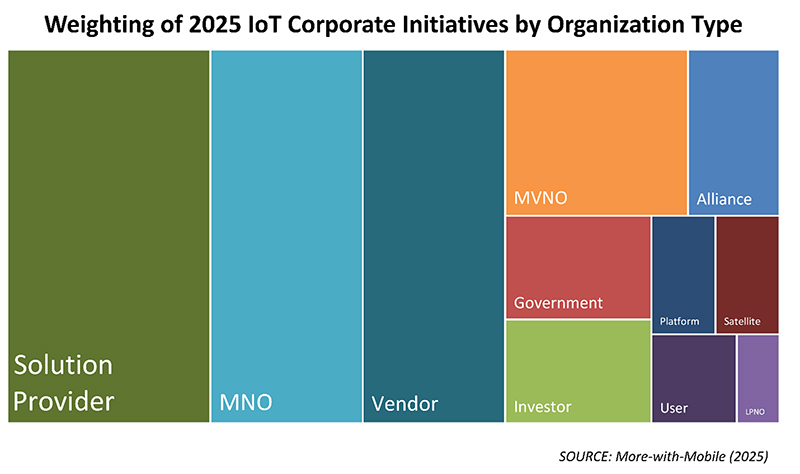
‘Solutions’ map to the upper layers of the IoT stack. Below these are the industry layers that deal with ‘connectivity’ and ‘connected devices.’ Connectivity shows up in the form of MNO, MVNO (virtual), LPNO (low power), and satellite connectivity providers. A continuing development in 2025 is the rapprochement between cellular and satellite industries. This was best expressed by a policy executive who remarked that it was now not uncommon to come across satellite industry representatives in meetings at the GSMA’s offices.
Underpinning solutions, the coverage aspect of connectivity continues to matter for the industry. A few examples are: Vodafone’s partnership with Mobily to expand the former’s Saudi Arabian footprint; SingTel addressing global IoT deployments by allying with FloLive; and, Verizon adding SingTel and Skylo partnerships for global IoT.
Working Across the IoT Industry Chain
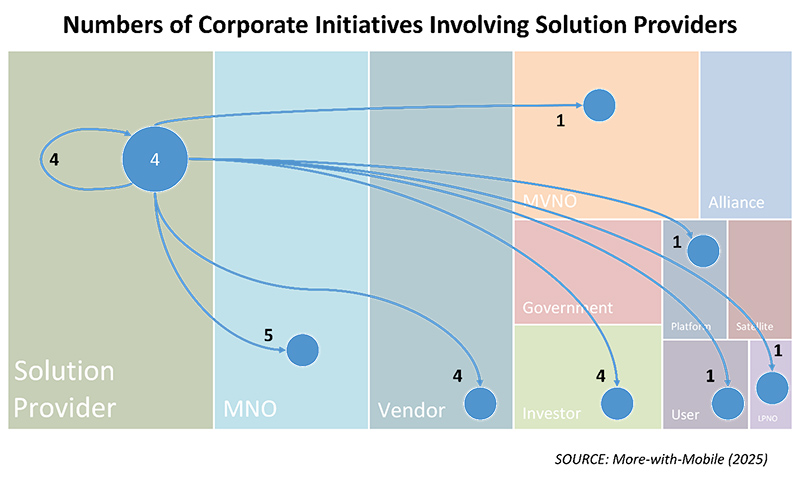
Connectivity partnerships – one MNO partnering with another MNO from a different geographic region – are a form of in-segment or horizontal industry initiative. However, effective IoT spans the industry chain because several elements are essential for a complete solution. One way to visualize this is by studying cross-industry connections. For 2025, these amounted to over 60% of the initiatives. Solution Providers, for example, are a good example of cross-segment reach. In addition to standalone solution provider initiatives (4), organizations in this segment partnered with other solution providers (4), MNOs (5), vendors (4), and investors (4).
Vendors Unlock New Industry Segments
The third-ranking group in the industry map is vendors. Many of their initiatives focused on connected devices and capability enhancements. Examples include G+D launching a credit card sized IoT tracker for shipping applications and Sequans using the acquisition route to boost its RedCap activities.
Across the industry, the topic of Edge IoT continues to capture attention. Qualcomm was most consistent in illustrating how this dynamic is playing out. Its corporate initiatives included the acquisition of Edge Impulse with an emphasis on AI and IoT capabilities. Qualcomm then established an AI and IoT engineering center in Abu Dhabi before acquiring Arduino to improve developers’ access to edge computing and AI.
Governments’ Growing Role in IoT
With IoT becoming more central to the economy, government will have an increasingly important influence on the market. Three developments illustrate trends for the future. Firstly, European regulators approved a unified framework for non-cellular satellite IoT, overcoming years of patchwork regulation. Middle East regulators are likely to follow.
In India, there are plans to develop an IoT-ready UPI (universal payments infrastructure) system to automate payment transactions through smart devices and not just phones. This would enable UPI payments through smart devices like TVs, fridges, washing machines, cars, and smart watches, among others.
Finally, the USA will require U.S. Cyber Trust Mark labeling on all federally procured connected devices after January 4, 2027. The requirement that connected devices meet baseline cybersecurity standards (secure software updates, data protection measures, and vulnerability reporting mechanisms) will have spillover effects into the wider IoT market.
Promise and Peril
Towards the year end, Vodafone and 1NCE initiatives drew attention to much greater promise for the IoT came. In the case of Vodafone, its Americas Managing Director, Dennis Nikles, described plans to act on Vodafone’s hyperscaler ambition for IoT. This will involve a shift from scale to hyperscale (a topic I have covered in the past), partnering (in place of competing), and simplification (to cut complexity and costs) as a strategy.
The second development, addressing the importance of moving beyond ‘connectivity’ as a value proposition came from 1NCE’s launch of its ‘Fixers’ line of business. This aims to expand beyond software and connectivity by leveraging implementation experience from over 27,000 customers. ‘Fixers’ will provide advisory services on building better IoT solutions, driving efficient usage of existing intelligent products, and debugging technical faults.
With IoT devices and systems becoming more prevalent, value creation opportunities multiply as does the prospect for peril. Two stories illustrate grounds for concern. The first involves French authorities arresting two crew members of a passenger ferry. They are suspected of infecting the ship with malware with the possibility of remotely controlling the vessel.
In the second story, Andrej Karpathy, a cofounder of OpenAI, experimented to see if Claude Code could get into his home automation system. His prompt led Claude Code to find his Lutron controllers on the local Wi-Fi network (check for open ports, connect, get metadata, and identify devices and their firmware). There followed an Internet search for the PDF for his system and then instructions on what button to press to pair and get necessary certificates. It then connected to the system and found all his home devices (lights, shades, HVAC temperature control, motion sensors etc.). The routine then ran checks by turning his kitchen lights on and off.
Prospects for 2026
Industry developments over the course of 2025 point to an evolution in industry mindset, with larger organizations addressing new market and business growth opportunities. These go beyond connections and connectivity as IoT meshes with complementary technologies such as AI, digital twins, data with meaning, and payments. As combinations of these technologies work their way into industry and public infrastructure, there remain questions about how the IoT industry will deal with adversity arising from malicious actors to accidental engineers over-relying on generative AI. There must be sources of opportunity for value added propositions targeting users and infrastructure via data protection, security, and trustworthiness propositions.
The post 2025 in Review: From calamity to promise and peril appeared first on IoT Business News.