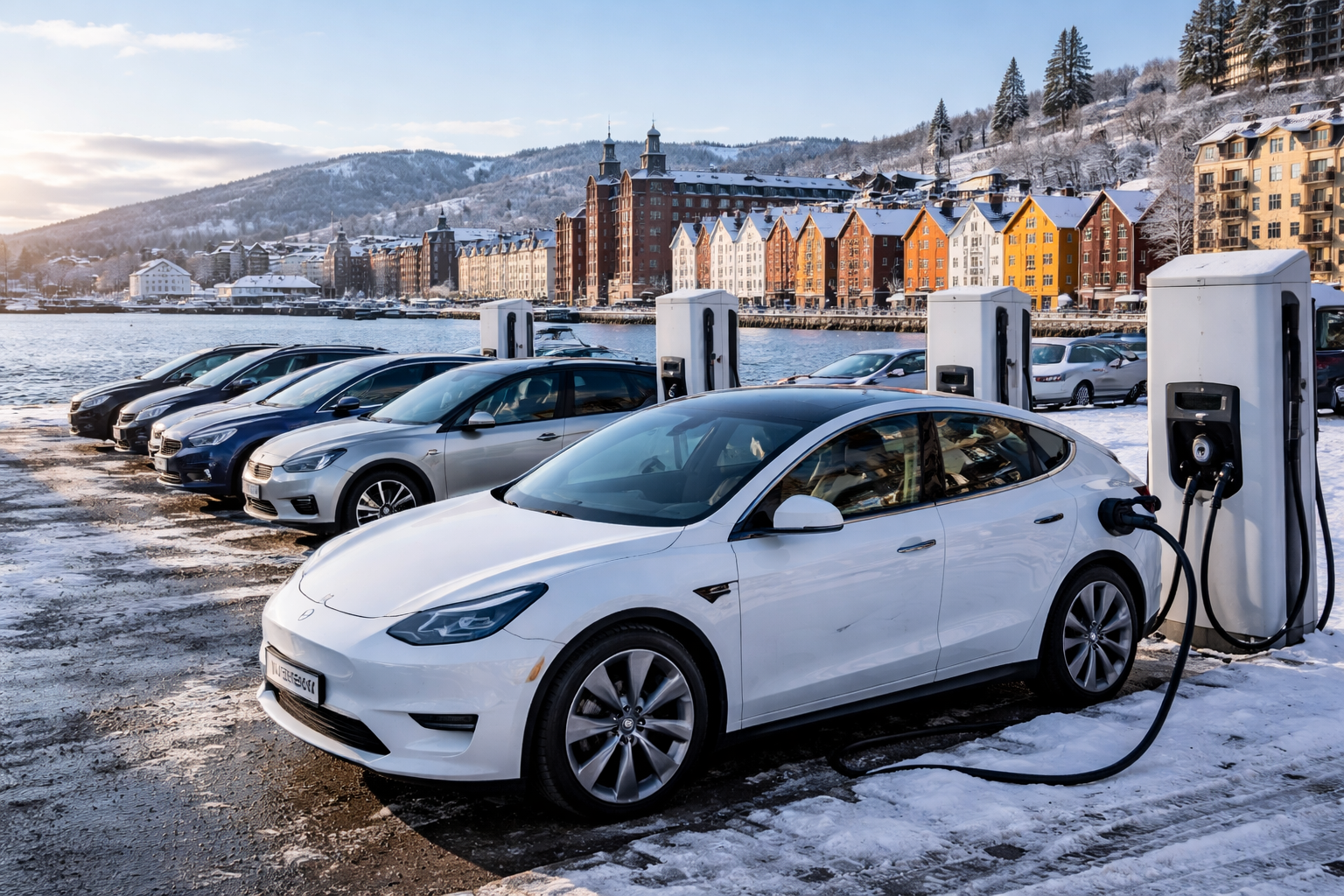
Norway moved within striking distance of effectively eliminating gasoline and diesel cars from its new car market after electric vehicles accounted for nearly all new registrations last year, reinforcing the country’s position as the world’s leading adopter of EVs.
Data published on Friday by the Norwegian Road Traffic Information Council, known as OFV, showed that 95.9% of all new cars registered in 2025 were fully electric.
The figure rose to 98% in December alone, highlighting a powerful year-end surge in demand.
The annual share was sharply higher than the 88.9% recorded at the end of 2024, underscoring the pace at which the Nordic country is closing in on its long-stated ambition to phase out internal combustion engine vehicles.
Record volumes driven by policy and timing
Norway registered a record 179,550 new passenger cars in 2025, a 40% increase from the previous year and the highest annual total ever recorded in the country, according to OFV.
The jump broke the previous record set in 2021.
OFV director Geir Inge Stokke described 2025 as an exceptional year for the market, pointing to the impact of long-running government policy and recent tax decisions.
“We see the effect of long-term and targeted electric car policy, and how specific tax decisions have immediate effects on the market,” Stokke said in a statement.
He added that a rush of purchases toward the end of the year was partly driven by an upcoming change to value-added tax rules from January 1, 2026, prompting many buyers to bring forward their decisions and secure an electric car before the deadline.
Tesla bucks European slump in Norway
Norway’s near-total electrification of new car sales has also produced sharply different outcomes for automakers compared with the rest of Europe, particularly for Tesla.
While Tesla registrations fell steeply in several major European markets in December, they surged in Norway, confirming a pattern that has seen the US carmaker thrive in Europe’s most EV-friendly country even as its broader regional market share erodes.
In France, Europe’s third-largest car market after Germany and Britain, Tesla registrations slumped 66% in December to 1,942 vehicles, according to data from French auto body PFA.
For 2025 as a whole, Tesla registrations in France fell 37%.
In Sweden, Tesla registrations dropped 71% in December to 821 vehicles, contributing to a 70% decline over the full year, based on figures from Mobility Sweden.
By contrast, Tesla registrations in Norway jumped 89% in December from a year earlier to 5,679 vehicles.
The brand captured more than 19% of the Norwegian market in 2025, setting a new annual sales record as it benefited from a market where almost all new car purchases are electric.
Decades of incentives shape consumer behaviour
Experts say Norway’s global lead in EV adoption is no accident but the result of decades of consistent policymaking.
Government support for electric vehicles began as early as the 1990s, long before most other countries considered large-scale electrification of transport.
In 2017, Norway set a target to end sales of new internal combustion engine cars by 2025, the most ambitious timeline of any country.
While petrol and diesel vehicles have not been entirely eliminated, the latest figures suggest the target has been all but achieved.
Adam Rodgers, global business development director at charging company Easee, said Norway’s adoption rate reflects a carefully structured incentive programme designed to smooth the transition for consumers.
“Norway’s world-leading EV adoption rate is the result of a long-term and well-structured incentive programme that focuses on creating a seamless transition,” Rodgers said in a report published by EV Magazine after Norway reached a 96.9% EV market share in January 2025.
Financial and practical advantages combine
Norway’s approach has combined financial incentives with everyday benefits that made electric cars attractive beyond environmental considerations.
Measures included reduced import duties between 1990 and 2022 and exemptions from VAT for many years, significantly lowering the upfront cost of EVs compared with conventional cars.
The absence of a large domestic car manufacturing industry also played a role.
Without a powerful automotive lobby to protect legacy jobs, policymakers faced fewer obstacles in pushing forward aggressive regulations, unlike in countries such as Germany, the UK or the United States.
Practical incentives further strengthened the case for EV ownership.
Electric car drivers have benefited from access to bus lanes, reduced tolls and preferential parking, making EVs not just cheaper to run but often more convenient in daily use.
A clean grid and charging advantage
Norway’s electricity system has also been a decisive factor.
More than 90% of the country’s power production comes from hydropower, often generating surplus electricity that can be used for vehicle charging.
Most Norwegians are able to charge their vehicles at home rather than relying on public infrastructure.
A 2022 study by the Norwegian EV Association found that around three-quarters of EV owners live in detached homes, making home charging easier.
Consultancy LCP has estimated that 82% of EVs in Norway are charged at home, though the share is lower in dense urban areas.
The government has also invested heavily in public charging networks.
Norway now has the highest number of public fast chargers per capita in the world, with many capable of charging an EV battery from zero to 80% in about 20 minutes.
Costs, critics and contradictions
The scale of Norway’s incentives has not been without controversy.
Bjorne Grimsrud, director of the Oslo-based transport research institute TOI, has said the measures have been costly, even if affordable for a wealthy country.
The government previously collected around 75 billion kroner a year from car-related taxes and tolls, a figure that has since been roughly halved, Grimsrud told Deutsche Welle last year.
Some lawmakers have also questioned the fairness of EV incentives, arguing they disproportionately benefit higher-income households and may come at the expense of other sustainable transport options such as walking, cycling and public transit.
Norway’s broader climate role has also drawn scrutiny.
Despite its green credentials at home and a target of carbon neutrality by 2030, the country remains a major oil and gas producer, creating a tension between its domestic transport policies and its reliance on fossil fuel revenues.
The post How Norway engineered world’s highest electric vehicle adoption rate appeared first on Invezz