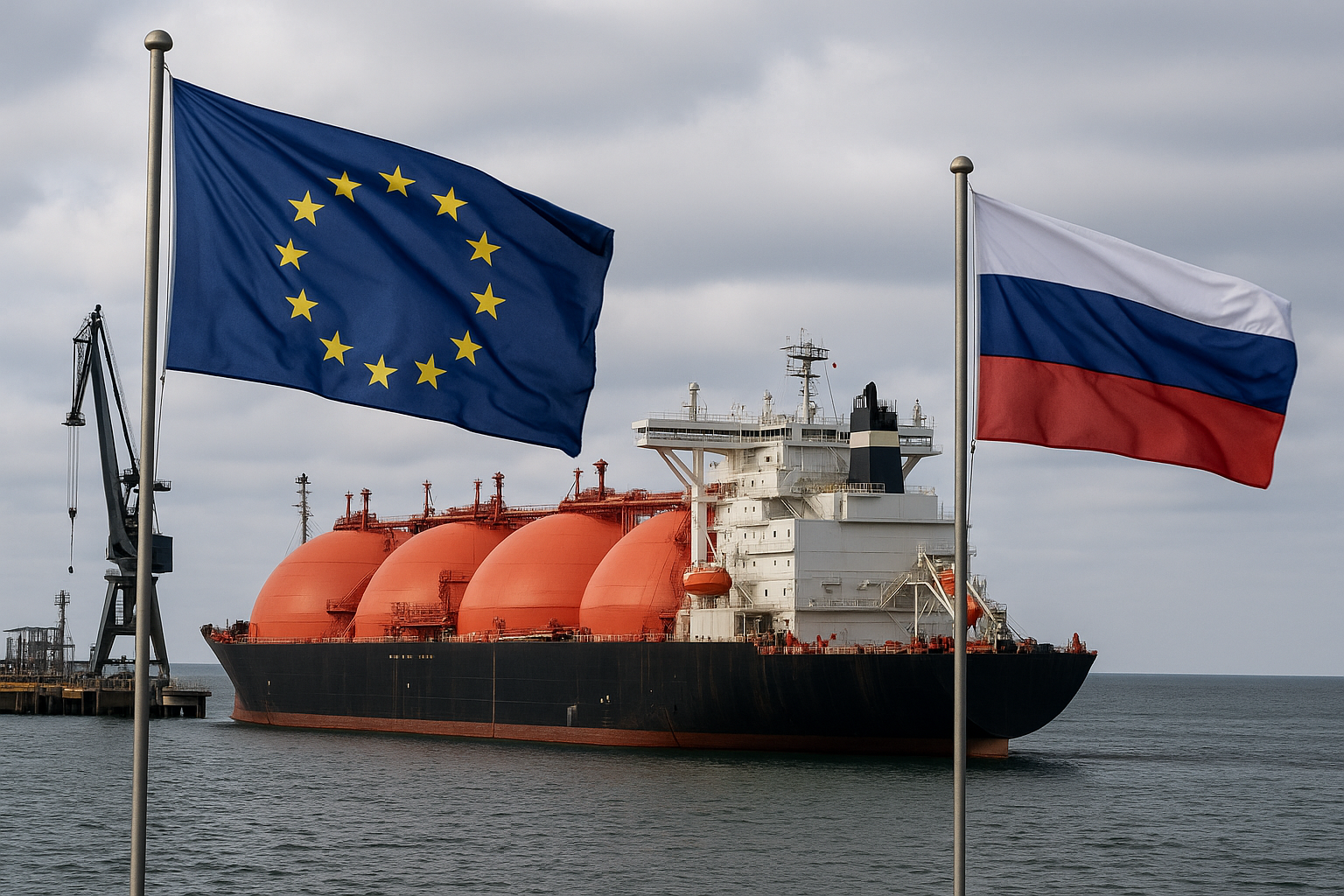
The European Union has approved its 19th sanctions package against Russia, marking one of its strongest joint efforts with the US to disrupt Moscow’s ability to fund its war in Ukraine.
The new measures target Russia’s energy infrastructure and the network that has helped it bypass earlier restrictions, signalling a coordinated Western strategy to curb Kremlin-linked revenues before 2027.
The package, adopted after weeks of internal debate, includes a future ban on liquefied natural gas (LNG) imports from Russia, tighter rules on oil transactions, and fresh action against ships involved in sanctions evasion.
It complements the US’s latest measures against major Russian producers Rosneft PJSC and Lukoil PJSC, underscoring a unified front aimed at closing loopholes across global markets.
LNG ban from 2027 marks turning point in EU’s energy policy
According to Denmark, which currently holds the EU’s rotating presidency, the bloc has agreed to halt all imports of Russian LNG by 2027.
The move marks a significant policy shift, completing Europe’s gradual decoupling from Moscow’s energy supplies since the 2022 invasion of Ukraine.
The EU has already reduced its dependence on Russian gas, but LNG imports have remained one of the last links connecting European energy firms with Russian exporters.
The upcoming ban will cut off billions in annual revenue for Russia’s energy sector, further straining its war economy as Western allies tighten enforcement.
At the same time, the EU aims to strengthen cooperation with alternative suppliers, including the US, Qatar, and African producers, to safeguard long-term energy security.
Crackdown expands to 117 shadow fleet vessels and oil traders
A key part of the new sanctions targets the so-called “shadow fleet” of vessels that transport Russian oil and LNG under complex ownership structures to evade existing restrictions.
The EU has sanctioned 117 additional ships believed to be operating under this network, which has been critical to sustaining Russian exports despite previous bans.
The bloc has also expanded transaction restrictions on two of Russia’s largest oil companies, Rosneft and Lukoil.
These companies were previously allowed to trade under certain exemptions related to global energy stability, but the new measures narrow those loopholes significantly.
These restrictions align closely with new US sanctions introduced just a day earlier, targeting the same firms and their trading subsidiaries.
Together, the transatlantic measures mark one of the most comprehensive attempts yet to choke off Moscow’s access to shipping, financing, and energy trade routes.
Sanctions progress after resistance from Austria, Hungary, and Slovakia
The adoption of the 19th sanctions package followed weeks of resistance from member states that rely more heavily on Russian energy, including Austria, Hungary, and Slovakia.
Their objections centred around energy security and the economic impact of further restrictions, delaying the package’s approval until compromises were reached.
However, the growing alignment between Washington and Brussels ultimately helped push the deal through. European policymakers viewed the package as essential to maintaining pressure on Moscow and signalling to global markets that sanctions evasion will face tougher scrutiny.
The coordinated timing of the EU and US announcements reinforced this message, with both sides moving to close remaining gaps in enforcement across oil, gas, and maritime sectors.
Western allies tighten coordination against Russia’s war economy
By synchronising their sanctions, the EU and the US are not only targeting Russia’s export revenues but also signalling long-term unity in their response to the war.
This approach is intended to make it harder for Russia to redirect its exports through intermediaries or sympathetic nations.
The latest measures reflect how Western allies are gradually moving from reactive sanctions to a more strategic framework—one that focuses on weakening Russia’s economic resilience and its capacity to sustain prolonged military operations.
As the war enters its third year, the renewed emphasis on energy sanctions highlights a broader recalibration of Western strategy: reducing dependence, reinforcing enforcement, and constraining Russia’s access to global capital and logistics networks.
The post EU adopts new Russia sanctions package targeting LNG and shadow fleet appeared first on Invezz