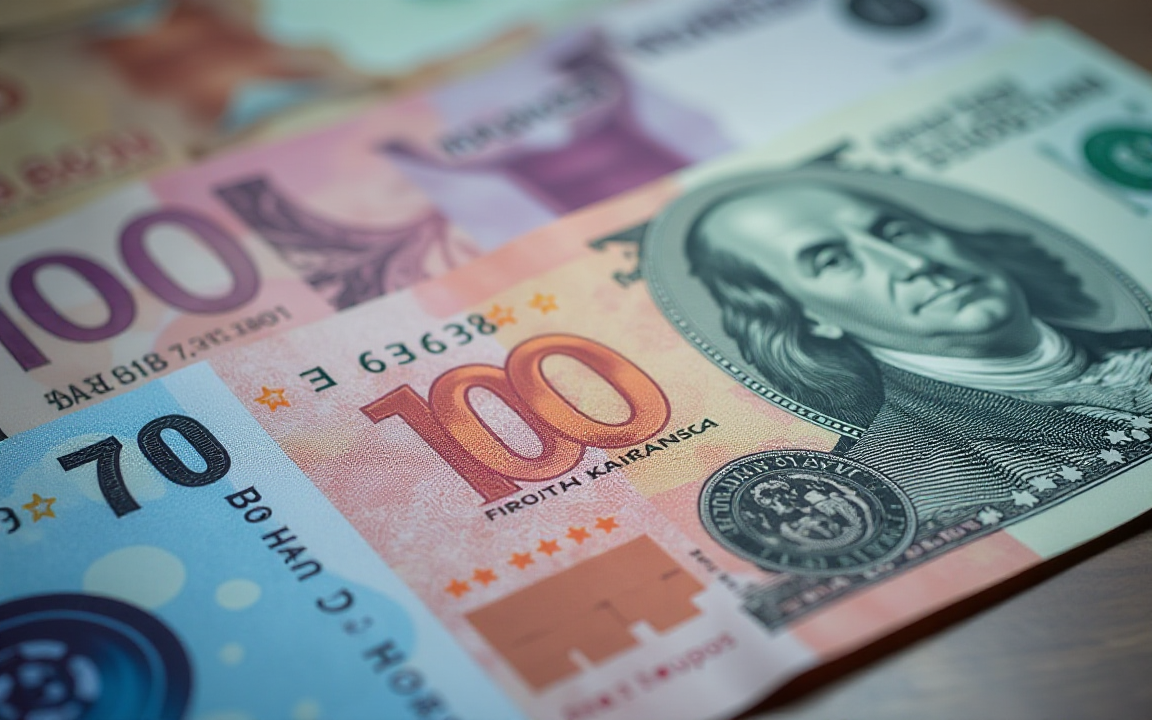
Asian currencies dropped sharply on Friday, with South Korea’s won and Malaysia’s ringgit suffering the steepest declines, as US President Donald Trump announced sweeping new tariffs on imports from dozens of trading partners.
The move sparked a retreat from riskier regional assets, highlighting investor anxiety about the direction of global trade policy.
The South Korean won weakened 0.69% to 1,401.53 per dollar, its lowest level in more than two months, while the ringgit shed 0.5% to hit its weakest mark since late June.
Both currencies are poised for their worst weekly performance since early 2024.
Doubts over South Korea’s reform agenda
Currency pressure in South Korea was exacerbated by domestic concerns after the government proposed reversing recent tax cuts.
Investors took the move as a signal that Seoul may be retreating from its push to reduce the so-called “Korea Discount” — a chronic undervaluation of South Korean equities relative to peers due to governance and policy concerns.
The benchmark KOSPI index tumbled 3.5% on the day.
Elsewhere in Asia, the Taiwan dollar and Thai baht declined more than 0.3%, while the Philippine peso recovered from earlier six-month lows to end the session flat.
The MSCI emerging market currency index fell more than 1% this week, snapping a six-month rally that had extended into July.
Trump’s tariffs shake trade outlook
The sell-off came after Trump signed executive orders late Thursday imposing new import duties ranging from 10% to 41% using emergency powers. India faces 25% tariffs on key exports to the US, while Taiwan was hit with 20%.
Malaysia and Thailand were levied at 19%, and South Korea secured a reduced 15% rate after last-minute negotiations.
“Tariff rates settling at 15-20% for most of the region outside of China will hurt producers, narrow profit along the supply chain and curtail US demand,” said Alex Holmes, regional director for Asia Pacific at EIU, noting that core emerging market countries with stronger fundamentals are expected to prove more resilient than frontier economies.
The tariffs are the latest in a series of moves that have heightened tensions between the US and its Asian trading partners.
Analysts said that while many in the region had prepared for a protectionist pivot, the broad and aggressive nature of the tariffs adds a new layer of complexity.
Central banks and trade partners brace for fallout
The US dollar rose broadly on the back of the announcement, gaining 0.3% on Friday and pushing the dollar index up 2.5% for the week — its strongest weekly showing in two months.
Regional stock markets posted mixed reactions: while Malaysia’s Bursa and Indonesia’s Composite Index each rose over 1%, likely buoyed by optimism over existing U.S. agreements, the reaction elsewhere was more muted.
Central bank responses are now in focus.
While the Monetary Authority of Singapore and Bank of Japan kept policy unchanged, India’s central bank meets next week, and Thailand’s decision is due shortly.
Analysts at Barclays expect the Reserve Bank of India to pause dovishly before moving toward rate cuts in October.
“A number of emerging market central banks appear to be shifting toward a more accommodative stance,” with India expected to deliver “a dovish pause” before likely cutting rates in October, Barclays analysts said.
Lorraine Tan of Morningstar said the revised tariff schedule was largely in line with expectations and would not significantly impact regional markets.
However, she and her colleagues noted that the delay in a final US-China trade deal, despite multiple negotiation rounds, raises questions about underlying progress.
“We think the new 90-day extension between China and US may be viewed as headwind by investors given that a framework seemed to be already in place for the last 3 months amid multiple rounds of negotiations,” Morningstar’s Asia equity market strategist Kai Wang said in the same Friday note.
“The extension is signaling that there may be some snags in talks which have the potential to fall apart entirely given that Trump is still indirectly targeting China through transshipping and other loopholes,” Wang said, adding that the performance of the Hang Seng Index and the CSI 300 index in the last two days largely supported this thesis.
The post Asian currencies reel as Trump’s new tariffs spark market jitters appeared first on Invezz