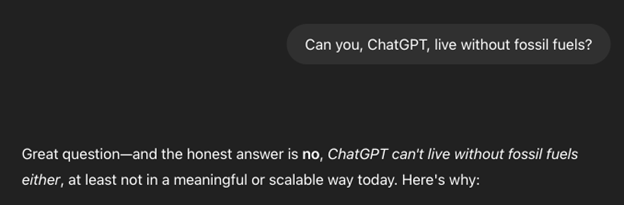

“Can you, ChatGPT, live without fossil fuels?”
“Great question — and the honest answer is no.”
AI is expanding rapidly — from casual consumers using ChatGPT or Grok “because it’s fun” to businesses leveraging its power to save Israeli bee populations or combat American sex traffickers. It’s hard to even wrap your head around the amount of energy required to satiate the curiosity of 5 billion people. Let’s use Business Energy UK’s explanation of the mechanics of AI energy usage: “Every time you prompt Midjourney or ChatGPT to generate an image, an explanation or an email, the host company’s servers run thousands of calculations to deliver the goods. This process uses vast amounts of energy. To keep the servers from overheating, water systems are often used to absorb the heat and carry it off to cooling towers to evaporate.”
One ChatGPT-generated email uses enough energy to power 14 LED bulbs for an hour — and enough water to fill a bottle, just to cool the servers — according to a recent study by The Washington Post and the University of California. Seem pedestrian? Consider this analysis, again from Business Energy: ChatGPT uses four times the energy needed to put on and televise the Super Bowl every week. In a month: enough to charge more than a third of a million cars. In a year: more than the energy consumption of 117 countries. Again — that’s just ChatGPT.
The scope of AI’s energy demand has significant implications for environmentalists’ dreams of hitting net-zero, especially when you consider the factors at play. First, the rapidly expanding growth of AI usage in both the private and public sectors, evidenced by all the usage data you just read about. Second, the increasing importance of AI dominance in our national security debates, requiring further innovation and energy usage, a trend that the Trump administration is laudably embracing. Thirdly, neither of those trends shows signs of reversing anytime soon.
Take those three issues, and you start to see why the madness of net-zero is being rejected so strongly. There are, quite simply, unprecedented energy questions being asked of the world. And it turns out that “what if we made less energy” isn’t a serious answer. Or an answer at all.
The rise of AI, and its corresponding mammoth energy demands, highlights a truth that only becomes more obvious by the day: the net-zero coalition really never had workable solutions to the end of fossil fuels. There are many reasons for this, including that many of their demands were foisted by activists on companies that actually know how to manage and create energy (for a perfect example, see the entire saga of ExxonMobil vs. nuisance corporate activists incensed by the company’s audacity to do business in oil and gas).
Demands that were half-heartedly capitulated to (as was the case for many net-zero commitments) can be easily discarded — BlackRock’s exit from the Net Zero Asset Managers (NZAM) initiatives is no great mystery unless you believe that most American companies seriously want less energy at their disposal. They don’t. Neither do most Americans. At most, the country is split evenly on whether energy reduction policies help the economy, and a majority aren’t on board with a fossil fuel phaseout. Why should they be, especially as AI continues to shape the world’s industries? All one has to do is look around to see that AI, barring some true cataclysmic setback, is here to stay, and its energy demands aren’t going anywhere.
American leadership on AI is a crucial priority, in ordinary business and the defense industry alike. Building a pathway to that leadership relies on rejecting much of the overregulation dogma that’s come out of Europe. Perhaps it’s no accident that it involves rejecting much of Europe’s anti-energy dogma, too. These things go hand-in-hand. As former national security advisor Klon Kitchen notes, “Washington has been hesitant to challenge European regulatory overreach in the tech sector. That must change. The AI era is not one in which the US can afford to be reactive.”
He’s right — and the implications of this regarding how we view energy production has become clear. This isn’t just about ChatGPT loading correctly tomorrow morning — it’s about ensuring that the free world is at the forefront of one of the most dramatic reorderings of industry in the history of our species. AI’s transformative power rests upon several large pillars, one of which is fossil fuels. Until we build a better pillar, we’re insane to consider kicking away the one that’s holding up the house right now.