Senator Ted Cruz wants a federal moratorium on state-level AI regulation, centralizing authority in Washington. But if the federal government takes control, who controls the bureaucracy that will decide which AI products get licensed — and which get banned?
Back in 2023, OpenAI CEO Sam Altman warned the US Senate that artificial intelligence posed risks on par with nuclear weapons. In hindsight, those warnings sound less like public service and more like strategic fearmongering — a bid to scare lawmakers into protecting OpenAI’s market position through regulation and multibillion-dollar subsidies for his Stargate infrastructure project.
Today, Altman sounds a different note: “I believe the next decade will be about abundant intelligence and abundant energy,” he told Politico. “We need to give adult users a lot of freedom to use AI in the way that they want.” But noticeably absent is any call to give AI developers the freedom to compete with OpenAI.
If wealth is knowledge and growth is learning, then AI promises a revolution in both — accelerating discovery and lowering the cost of insight. It can put eight billion people on exponential learning curves. But will heavy-handed regulation actually accelerate this transformation — or suffocate it?
Perhaps the greater benefit comes not from centralized control, but more competition — among AI companies and among governments themselves. Let nations and states compete to foster innovation.
What makes your local McDonald’s serve you better? It’s the Burger King across the street, not a government inspector with a clipboard. Competition drives better service, lower prices, and more innovation. Regulation protects incumbents, empowers bureaucrats, and often serves political interests more than the public. If you want better choices, more value, and faster progress — bet on open competition, not central control.
Remember, it wasn’t regulation that drove down the cost of AI models from $100 million to just $30. It was competition. And it happened in less than 60 days. That’s the power of open markets. That’s how progress happens.
Flags of Convenience for AI Innovation
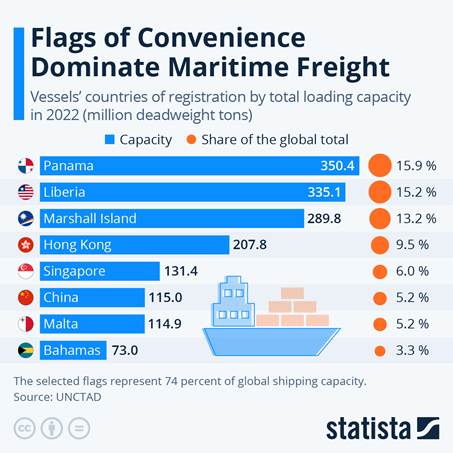
Flags of convenience refer to the practice of registering a merchant ship in a country other than that of the ship’s owner, usually to enjoy more favorable regulations, taxes, and labor laws. Four countries — Panama, Liberia, the Marshall Islands, and Hong Kong — account for over half of the world’s maritime freight capacity today.
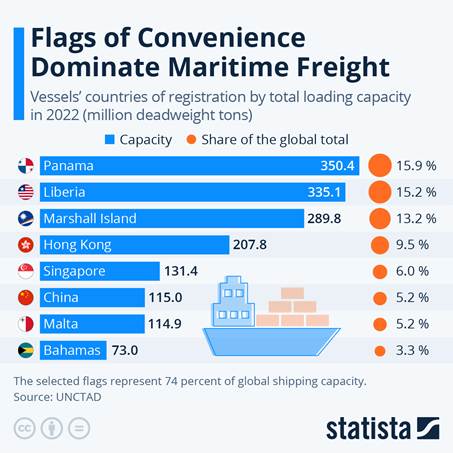
In the 1950s, the US registered 50 percent of global capacity. US registration has dropped almost 99 percent, to just 0.57 percent today. Could the same pattern repeat if the US government attempts to license AI?
“Capital goes where it is welcome,” noted the great banker Walter Wriston, “and stays where it is well treated.” By capital, Wriston meant both the capital in your wallet and the capital in your head.
Where Is AI Capital Welcome and Well-Treated Today?
While the US, the EU, and China build expansive bureaucracies to regulate and tax AI innovation, a new set of countries is emerging as “flags of convenience” for AI startups — offering low taxes, business-friendly environments, and innovation-focused policies.
Singapore stands out as the most advanced option, combining low corporate taxes, strong legal protections, world-class infrastructure, and active government support through its National AI Strategy. With top universities, generous R&D grants, and seamless access to Asian markets, it’s an ideal launchpad for globally ambitious AI companies.
Estonia offers a lean, digital-first alternative within the European Union. Known for its zero-percent tax on reinvested profits, fully online incorporation, and GDPR-compliant data policies, Estonia is perfect for small, privacy-conscious AI teams. Its tech-savvy population and transparent government create a strong foundation for early-stage innovation.
The United Arab Emirates provides a gateway to the Middle East with zero- to nine-percent corporate taxes, fast-track company formation in free zones, and a national strategy focused on AI and smart cities. With strong infrastructure and no income or capital gains tax, it’s well-suited for AI startups in logistics, finance, or government tech.
El Salvador, while less mature in its AI ecosystem, offers the boldest tax incentives — zero percent on income, capital gains, and import taxes for tech companies. With a pro-crypto stance and low cost of operations, it’s especially attractive to early-stage or decentralized startups seeking freedom from regulatory overhead.
Together, these four countries are positioning themselves as global safe harbors for AI innovation, providing startups with the flexibility, incentives, and strategic advantages to grow in an increasingly restrictive global environment.
As the AI revolution accelerates, the real question isn’t whether we need some rules — it’s who gets to make and impose them, and whether those rules will help innovation thrive or tie it down. The history of economic progress shows us that technological breakthroughs don’t flourish under monopolies or ministries or central planning — they flourish in open systems where people are free to build, experiment, and compete. That’s why a new wave of countries is stepping up as “flags of convenience” for AI, offering low taxes, simple rules, and room to grow.
The US has always led by encouraging bold ideas and letting people build. We can keep that lead in AI, but only if we stay open, value competition, and trust in the power of free individuals. If the US tries to control AI through heavy-handed licensing and regulation, we won’t stop the future. We’ll just watch it happen somewhere else.