A quiet town in Maharashtra found itself in an international spotlight this week.
Kolhapur, famed for its traditional leather chappals called the Kolhapuri chappals and intricate jewellery, played host to an unusual delegation from Italy.
On Tuesday and Wednesday, four representatives from the luxury fashion house Prada visited the town to gain insight into the making of the Kolhapuri chappal.
The visiting team included senior technical experts: Paolo Tiveron and Daniele Contu, along with consultants Andrea and Roberto Pollastrelli.
Their interest, however, wasn’t born in Kolhapur. It began in Milan.
How Prada’s sandals in Milan struck a chord with Kolhapuri chappals
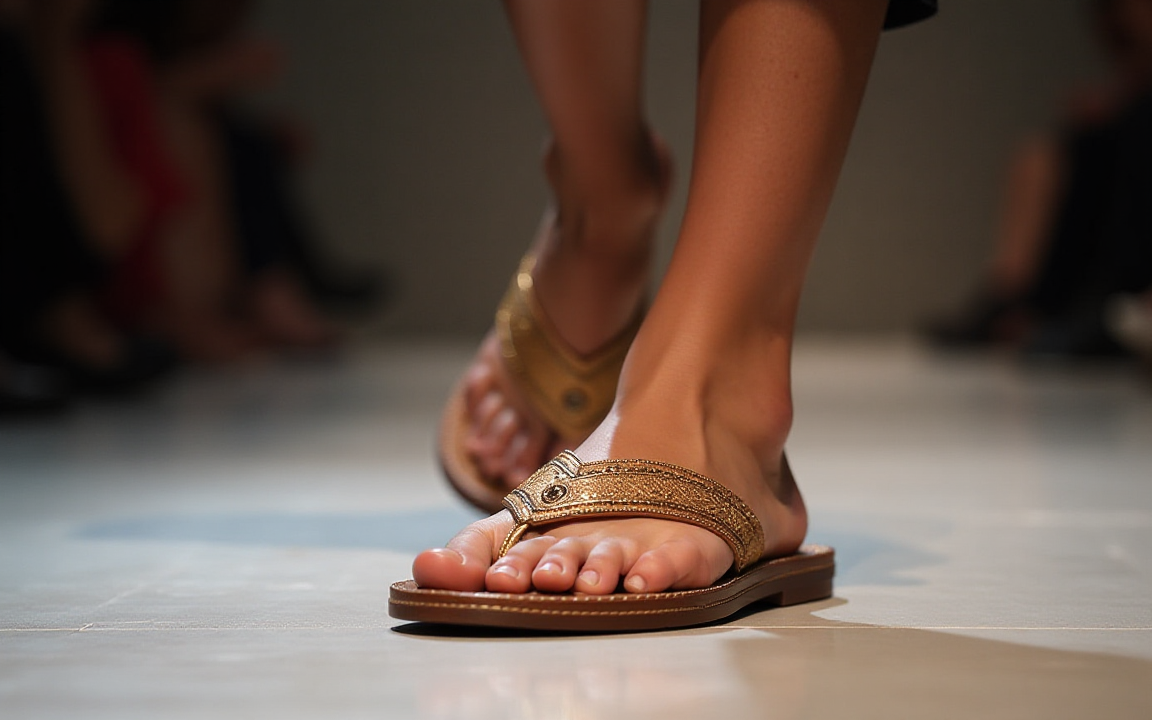
Last month, Prada’s Spring/Summer 2026 collection hit the runway in Milan, with several models walking in open-toe, T-strap leather sandals that bore a striking resemblance to Kolhapuri chappals.
Priced at around Rs 1.2 lakh each, the sandals sparked instant outrage in India for their uncanny similarity to the traditional Indian footwear, without any mention of their cultural or geographical origin.
Prada’s products are priced far beyond what most Indians can afford.
Its men’s leather sandals start at $844, while traditional Kolhapuri chappals, widely available in Indian markets and street stalls, typically begin at just $12.
Social media users in India swiftly called out the fashion house for cultural appropriation.
Many argued that while millions in India wore Kolhapuris daily, the credit and profit seemed poised to go elsewhere.
Kolhapuri chappal artisans caught in a fading craft
The controversy struck a nerve because the Kolhapuri chappal is not just any sandal.
With origins dating back to the 12th century, the chappals have been handmade by local artisans for generations.
Today, only around 5,000 artisans in Kolhapur continue the craft, many facing poor working conditions and declining wages.
Nationwide, the industry engages about 100,000 workers, according to the Maharashtra Chamber of Commerce, Industry & Agriculture (MACCIA).
The local community, already battling to keep the craft alive in a mechanised global marketplace, saw Prada’s silence as both a commercial slight and a cultural insult.
Legal route resorted to claim compensation for reputational harm
Soon after the runway debut, MACCIA and other organisations demanded acknowledgment and fair compensation.
Advocate Ganesh S Hingmire filed a Public Interest Litigation (PIL) in the Bombay High Court, seeking to restrain Prada from marketing what it termed “toe ring sandals,” and accused the company of using a Geographical Indication (GI) tagged product without consent.
The PIL also called for a public apology from Prada and compensation for the artisan community, citing reputational and economic harm.
India had granted the Kolhapuri chappal GI tag in 2019, legally tying the design and production to eight districts in Maharashtra and Karnataka.
However, the court dismissed the PIL on Thursday on procedural grounds, stating that only producers’ associations could file such complaints under the GI law.
Prada acknowledges Indian roots
In response to the backlash, Prada issued a statement acknowledging the inspiration behind the sandals.
Lorenzo Bertelli, head of corporate social responsibility and son of Prada’s owners, wrote to MACCIA recognising the centuries-old Indian heritage of the design.
“We acknowledge that the sandals are inspired by traditional Indian handcrafted footwear,” Bertelli wrote.
He added that the product was still in the early stages and may not be commercialised.
However, Prada expressed interest in opening a dialogue for collaboration with Indian artisans.
A company spokesperson further added that Prada has always celebrated craftsmanship and heritage and is open to arranging follow-up meetings with artisan groups.
Controversy boosts the visibility of Kolhapuri chappals and sales
While the legal debate continues, several Indian footwear brands have seized the moment to boost visibility and sales.
According to Reuters, Mumbai-based Ira Soles ran online ads proclaiming their Kolhapuris had “just walked the ramp at Prada,” marketing their $32 chappals as global fashion statements.
Similarly, Niira, another domestic brand, offered discounts and highlighted its designs as “rooted in tradition.”
Founder Nishant Raut reported a tripling in sales since the controversy began.
Echoes of previous appropriation rows
The Prada episode echoes earlier controversies, such as when British designer Paul Smith marketed a sandal resembling the Peshawari chappal from Pakistan.
Back then, the company eventually updated its product description to include the design’s cultural roots.
Experts note that while GI tags offer recognition and authenticity, they do not outright prohibit others from selling similar designs, as long as the product is not falsely advertised.
“Prada would be within its right to sell Kolhapuri sandals at whatever markup it wanted if it sourced the items from the eight districts in Maharashtra and Karnataka that are covered by the geographical indication tag,” said Subhang Nair, an intellectual property lawyer, in a NYT article.
Another expert cited by the NYT, Priyam Lizmary Cherian, pointed out that Prada did not claim the product to be a Kolhapuri chappal but merely described it as inspired by one.
Cultural heritage meets global markets
Beyond the legal questions, the incident has reignited conversations about the value of cultural heritage in the luxury market.
India’s luxury sector is on a growth trajectory, expected to reach $17.94 billion by 2033, according to industry estimates.
A significant part of this expansion is driven by artisanal and heritage-based brands, especially among younger and more socially conscious consumers.
Luxury players like Louis Vuitton have already tapped into this sentiment through collaborations with Indian artists and designers, such as architect Bijoy Jain and musician AR Rahman.
These ventures have managed to honour craftsmanship while expanding market reach.
Prada’s case presents a contrast. Its isolated use of a traditional Indian design without collaboration or clear credit initially alienated many.
Yet, its willingness to engage after the backlash might still pave the way for meaningful partnerships.
The post Kolhapuri vs couture: How Prada’s sandal sparked a cultural row in India appeared first on Invezz