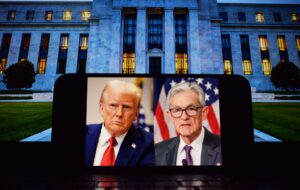
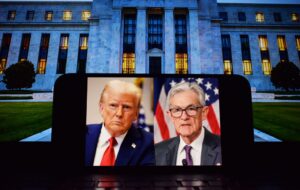
The tension between President Donald Trump and Federal Reserve Chair Jerome Powell has reignited, following the Fed’s recent decision to hold interest rates steady. President Trump stated again that he might consider firing Powell, something he had previously ruled out. With unemployment still low and output not yet showing signs of contraction, the Fed has judged that the current policy stance is appropriate. Inflation, while lower than its peak, remains above target, leaving little room for interest rate cuts without risking renewed price pressures. Yet Trump prefers a lower interest rate, a policy that might, in the short run, counteract his policy on tariffs.
Trump’s push for lower interest rates creates economic and institutional problems. The first is macroeconomic. By lowering rates in the face of still-stubborn inflation, the Fed risks undoing the fragile progress made since the post-pandemic surge in prices. While lower rates could offer some short-term relief from the economic drag caused by trade tensions and the recent spike in tariffs — many of Trump’s own making — they would do so at the risk of future inflationary pressure. That’s a dangerous trade-off. Monetary easing in a context of persistent inflation is more likely to produce stagflation than sustainable growth.
The second problem is institutional, which is arguably more damaging in the long run. Political interference in monetary policy compromises the independence and credibility of the central bank. The Fed’s legitimacy rests on its ability to act according to economic data, not political pressure. If monetary policymakers can be cajoled into taking actions that align with electoral timelines or partisan agendas, the public will likely expect higher inflation. That would put the Fed in a difficult position: deliver the higher inflation expected by the public or risk a recession.
Two historical precedents underscore the importance of central bank independence in very different ways. Fed Chair Arthur Burns gave in to President Nixon’s pressure campaign: he lowered interest rates ahead of the 1972 election, when doing so was unwarranted by the economic data, contributing to the high inflation of the 1970s. Fed Chair Paul Volcker refused to give in to pressure from President Reagan, who wanted the Fed chair to commit to not raise rates ahead of the 1984 election. Volcker was not planning to raise rates any further at the time, but refused to commit nonetheless. Volcker’s approach helped restore price stability and solidified the Fed’s reputation for independence. That legacy is now at risk.
President Trump’s calls for the Fed to cut rates risks undermining the institution, regardless of how the Fed responds. If the Fed were to cut rates today, the public might view the decision as a capitulation to political demands. If the Fed refuses to cut rates, as it has done since December 2024, the public might wonder whether the decision was at least partially driven by Fed officials’ desire to avoid the perception of yielding to political pressure. In either case, therefore, the public might come to believe the Fed is responding to political factors rather than economic data. Hence, the integrity of monetary policy suffers either way.
Credibility is hard earned and easily lost. That credibility is especially important in the international context. As the issuer of the world’s primary reserve currency, the US dollar’s value depends not only on the economic fundamentals in the United States, but also on the belief that the Fed will conduct policy in accordance with the economic fundamentals. Political meddling undermines that belief. A politicized central bank is one that foreign investors and trading partners may learn to doubt. Additionally, it can have a negative impact on the US Treasury’s international market.
With signs of disagreement emerging within the Fed’s Board of Governors on whether to pivot toward rate cuts later this year, the institution finds itself in a difficult position. Even if the eventual decision is economically justified, it risks being interpreted through a political lens. It is also likely that the Trump administration will publicly claim a victory over the Fed when cuts eventually begin, encouraging the political interpretation. In sum, the damage is already done: not necessarily to inflation or employment, but to the foundational principle of sound money itself.