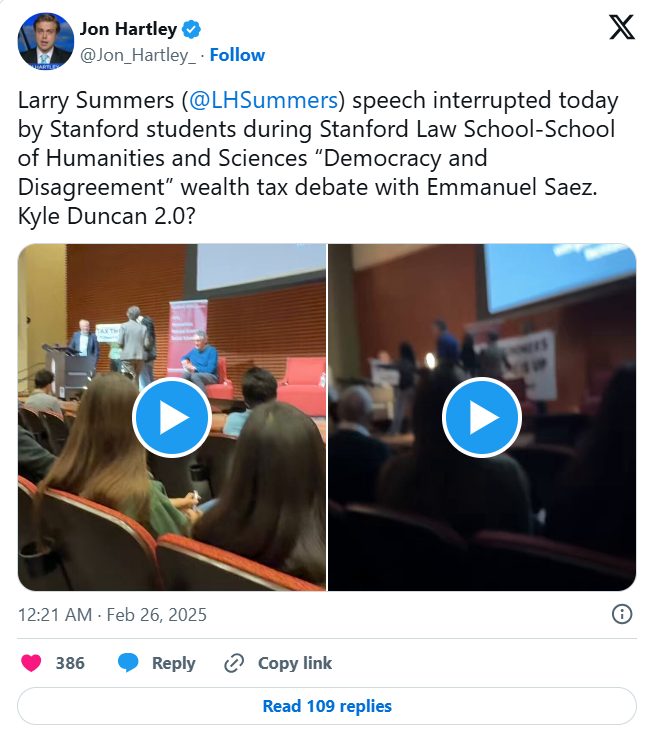
Last week, climate activists took the stage to interrupt a lecture by economist Larry Summers at Stanford Law School. The activists, who reportedly are members of Climate Defiance and apparently are not students, chanted and shouted over Summers for a full 10 minutes, preventing him from delivering much of his speech.
Summers, the former president of Harvard and an economist who served as Secretary of the Treasury during the Clinton Administration, told the protestors that he would respond to their comments if they could sit quietly until the Q&A portion of his talk, but no dice: they continued yelling that Summers was a “climate criminal” and chanting “Tax the rich!”
These kinds of disruptions are common, unfortunately.
On campus after campus, protestors — often, but not always, students — are employing what’s called the “heckler’s veto” to disrupt events and prevent speakers they dislike from speaking. In 2024, the Foundation for Individual Rights and Expression (FIRE) tracked 21 campus speeches, commencement speeches, or performances in which protestors caused so much ruckus that the events were suspended or canceled.
Here’s where the Stanford story gets interesting: in this case, the students didn’t take the disruption lying down. Nor did they side with the protestors and form a mob to heckle Summers off the stage. Instead, they condemned the protestors, yelling at them to “get off the stage” and “let [Summers] speak.”
These students were right to fight back. Shout downs like the one organized by Climate Defiance don’t actually hurt the speakers. Summers, as a famous economist and former president of Harvard, will probably find that his career is just fine after this latest interruption. It’s not like he’ll have to forfeit his speaking fee. The real victims of the shout down were the Stanford students themselves.
Summers was invited to speak as part of a series titled “Democracy and Disagreement,” in which scholars on opposite sides of certain hot-button topics meet to debate and to model civil disagreement. The protestors who interrupted Summers were primarily harming students, who showed up to the lecture on a Tuesday afternoon hoping to learn something from a respected economist and were instead treated to the childish antics of the protestors. Shout downs are an example of what Tim Urban calls “Idea Supremacy:” the notion that if the protestors don’t like what a certain speaker has to say, then no-one should be allowed to hear that speaker. They are inherently selfish.
The great free speech champion and former slave Frederick Douglass once said that, “To suppress free speech is a double wrong. It violates the rights of the hearer as well as those of the speaker.” He could have had the Climate Defiance disruption in mind when he spoke.
While shout downs like this are a common tactic, the fact that the students were willing to stand up for their right to hear Summers is an encouraging sign. In any such disruption on campus, the protestors are almost always a small minority. Students pay good money to attend university, along with a lot of time they could be spending working. Most students want that investment in time and energy to be repaid. They come to campus to learn. When these students stand up to the protestors, the protestors are left to scuttle off in defeat and lectures can go on.
The same Idea Supremacy animates campus disruptions, attempts to deplatform or disinvite speakers who have the wrong views, and cancellation mobs in the real world. In each case, a small number of ideologies tries to bully the silent majority into going along with their desires. When this majority refuses — when they instead stand up for their rights — they can change the culture of not just their campuses but also their communities, workplaces, and beyond.
When protestors try to disrupt an event, it’s essential that students speak up for their rights for another reason as well.
Many protestors insist that what they’re doing is actually engaging in free speech. The argument goes that, in the same way that Summers has a right to speak to a lecture hall that invited him, they have the right to invade that lecture hall and yell over Summers.
In reality, the heckler’s veto is not an exercise of free speech. Preventing someone else from being heard is not engaging in the marketplace of ideas; it’s just bullying.
But making this distinction is essential, because these students are in their intellectually formative years. As Urban writes in What’s Our Problem?, “According to a comprehensive study, people are at their most politically and ideologically impressionable between their mid-teens and mid-20s — so what they’re taught in college can stick with them forever.” It’s not just that young people who become liberal or conservative in college tend to stay that way as they age. It’s also that their ideas about bedrock American values are shaped during this time.
If no one pushes back on the idea that the heckler’s veto is just another form of free speech, then students are liable to leave campus thinking that it’s true. If these students think that shout downs and other forms of disruptive protest are in line with America’s august tradition of free speech, then they’re likely to come to one of two conclusions. First, that they should engage in shout downs themselves the next time someone speaks on a topic with which they disagree. Or second, that free speech is actually a bad idea because it creates too much chaos.
Neither conclusion is a good one for our society.
So, three cheers for the Stanford students who wouldn’t let a band of illiberal protestors rob them of their rights without a fight.
The greatest danger to free speech isn’t that our country will overturn the First Amendment; it’s that our culture will change to stop valuing free speech in the first place. As Greg Lukianoff, the president of FIRE, warns, “Free speech culture is more important than the First Amendment.… It’s what informs the First Amendment today — and it is what will decide if our current free speech protections will survive into the future.”
Stanford students just did their part to preserve that culture.